
The insurance industry in India has evolved significantly with the introduction of digital distribution channels and simplified insurance products. Today, customers can explore, compare, and purchase insurance policies through online platforms with greater convenience. Alongside this development, insurance distribution has also created opportunities for individuals who want to work in the insurance sector without following the traditional insurance agent model.
Two terms that often create confusion in this space are POS and POSP. Although they sound similar and are closely connected, they do not mean exactly the same thing. Understanding their differences is important for individuals planning to enter insurance distribution as well as customers who want to know who is authorised to sell their policies.
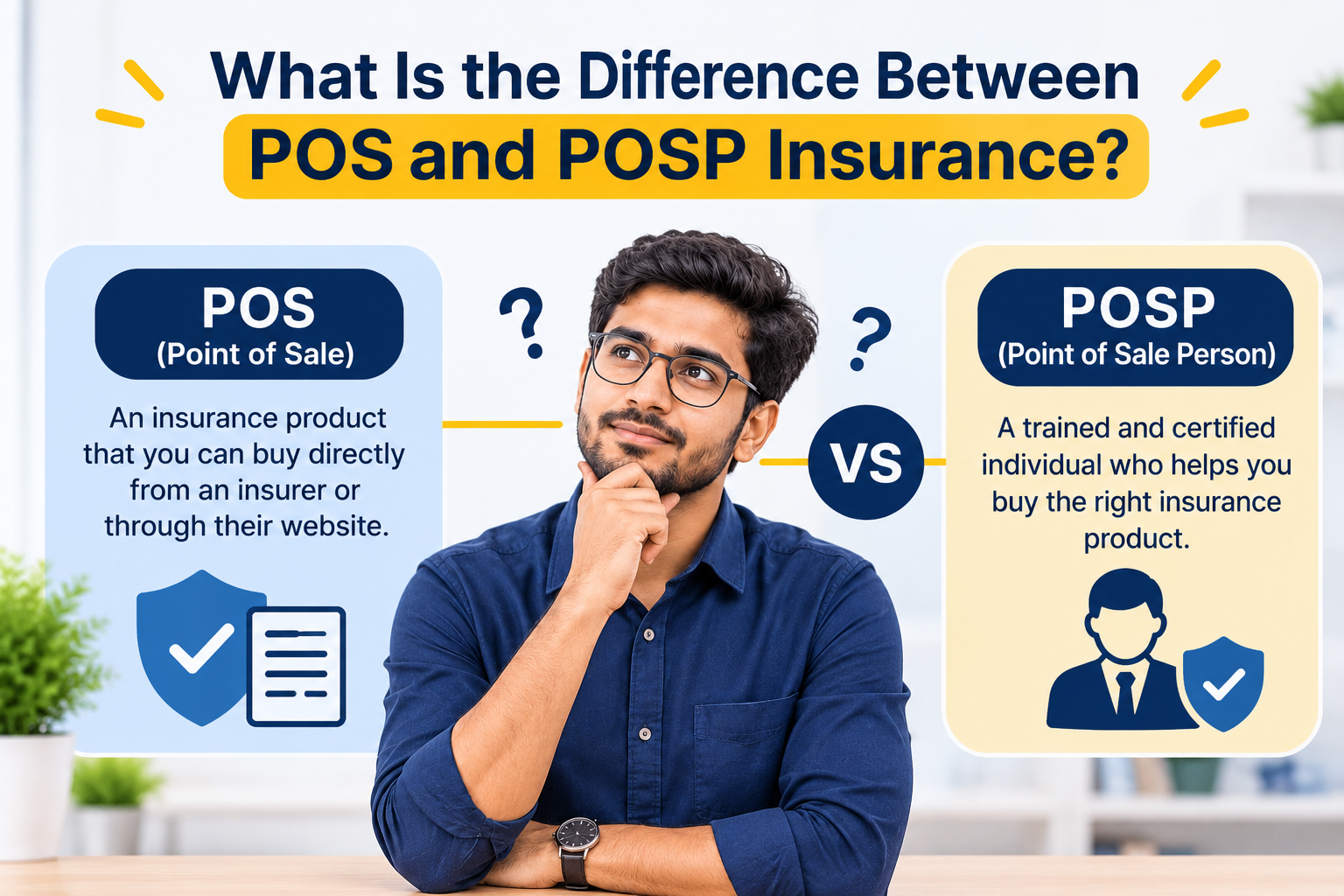
In simple terms, POS refers to Point of Sales, while POSP stands for Point of Sales Person. One describes a category of insurance products and the other refers to an individual authorised to distribute specified products.
Let's understand what POSP and POS insurance mean, how they work, and the key differences between them.
What Is POS Insurance?
POS insurance refers to insurance products designed with relatively standardised features and simplified coverage structures to make purchasing insurance easier for customers.
These products are intended to reduce complexity in the buying process. Instead of requiring customers to navigate extensive product variations, POS products generally have clearly defined coverage, eligibility conditions, and policy terms.
For example, an eligible point-of-sale health insurance product may offer predefined benefits and coverage conditions. Similarly, motor insurance products may provide standardised features that make it easier for customers to understand their coverage requirements.
The primary objective of POS insurance is to improve insurance accessibility, simplify product distribution, and help customers make informed purchasing decisions.
However, simplified products do not mean that customers should ignore policy documents. Coverage limits, exclusions, waiting periods, deductibles, and other conditions still need to be understood before purchasing a policy.
What Is POSP Insurance?
POSP stands for Point of Sales Person. A POSP is an individual authorised to sell specified insurance products after completing the prescribed training and certification requirements.
POSPs act as an important link between insurance companies or authorised insurance intermediaries and customers. They help individuals understand available insurance options, compare eligible products, complete proposal forms, and purchase suitable policies.
For example, a POSP insurance agent may help a customer select an eligible motor insurance policy, understand the available health insurance options, or purchase travel insurance.
To become a POSP, an individual generally needs to meet the applicable eligibility requirements, complete the prescribed 15-hour training programme, and pass the associated examination.
The POSP model provides an opportunity for freshers, working professionals, homemakers, and entrepreneurs to participate in insurance distribution, subject to the applicable regulatory framework.
POS vs POSP Insurance: Understanding the Key Differences
Although POS and POSP are closely related, their meanings, functions, and roles within the insurance ecosystem are different.
Here are the major differences to understand.
1. Meaning and Definition
The most fundamental difference is their definition.
POS refers to Point of Sales and is associated with a category of simplified insurance products that can be distributed through the point-of-sale framework.
POSP refers to Point of Sales Person, an individual authorised to distribute eligible insurance products.
In other words, POS relates to the insurance product framework, whereas POSP identifies the person involved in selling those products.
2. Purpose
POS insurance products are designed to make insurance easier to understand and purchase. Their simplified structure helps reduce complexity during the buying process.
POSP insurance distribution, on the other hand, aims to make insurance products more accessible by enabling trained and authorised individuals to reach customers.
While POS products focus on product accessibility, POSPs contribute to distribution and customer assistance.
3. Who Is Involved?
POS insurance is associated with insurers and authorised insurance intermediaries that offer or distribute eligible point-of-sale products.
POSP insurance involves individuals who have completed the required onboarding, training, examination, and authorisation process.
A POSP can help customers understand and purchase eligible products made available through their authorised association.
4. Eligibility and Requirements
POS insurance products must meet the applicable regulatory requirements for their product category and distribution framework.
For an individual to become a POSP, specific eligibility and certification conditions apply.
Generally, the candidate must:
-
Be at least 18 years old.
-
Have completed at least Class 10.
-
Submit the required identity and address documents.
-
Complete the prescribed 15-hour training programme.
-
Pass the associated examination and complete the necessary authorisation formalities.
These requirements help ensure that individuals involved in insurance distribution have a basic understanding of insurance products and their responsibilities.
5. Role in Insurance Distribution
POS insurance products provide a simplified way for customers to purchase eligible coverage.
POSPs play a direct role in helping customers access these products. They explain policy features, communicate important conditions, assist with proposal documentation, and guide customers through the purchase process.
Their responsibilities also include providing accurate information and avoiding misleading statements about policy benefits or claim settlements.
6. Earning Opportunities
Another important difference relates to earning opportunities.
POS insurance products do not independently represent an earning opportunity for an individual. They are insurance products distributed through authorised channels.
POSPs, however, can earn commissions through eligible insurance sales, subject to the terms of their association and applicable regulatory requirements.
Their earnings may depend on the products sold, premiums, sales performance, and applicable commission arrangements. POSP income is generally performance-based rather than a fixed monthly salary.
How Do POS and POSP Work Together?
POS and POSP are complementary parts of the insurance distribution ecosystem.
Consider a customer looking for health insurance. The customer may find it difficult to understand different policy features, waiting periods, coverage limits, and exclusions.
An authorised POSP can help explain the available eligible point-of-sale products and guide the customer through the purchasing process.
The POS insurance product provides the simplified coverage structure, while the POSP helps make that product accessible to the customer.
This relationship supports wider insurance distribution and can improve the overall buying experience when the POSP communicates product information accurately.
However, customers should always review the policy wording and understand the conditions before purchasing insurance.
Which Is Better: POS or POSP Insurance?
POS and POSP cannot be directly compared as competing insurance options because they serve different purposes.
If you are a customer looking for insurance, POS products may offer a simpler purchasing experience, depending on your coverage requirements. However, you should select a policy based on its benefits, exclusions, coverage limits, and suitability rather than choosing it simply because it is a POS product.
If you are an individual interested in entering the insurance industry, becoming a POSP may be worth exploring. It provides an opportunity to distribute eligible insurance products after completing the necessary training and certification.
Your choice should therefore depend on whether you are looking to purchase insurance or build a career in insurance distribution.
Conclusion
Understanding the difference between POS and POSP insurance helps remove confusion surrounding two important terms in India's insurance distribution industry. POS refers to the point-of-sale product framework, while POSP refers to the trained and authorised individual who distributes eligible insurance products.
Both contribute to making insurance more accessible, although their functions are different. Customers benefit from simplified purchasing options, while eligible individuals can explore professional opportunities through the POSP model.
If you are interested in understanding insurance distribution or exploring opportunities in this sector, Square Insurance can be a starting point for learning about the POSP ecosystem. Whether you are purchasing a policy or considering an insurance distribution career, always prioritise accurate information, regulatory compliance, and informed decisions.
Frequently Asked Questions (FAQs)
1. What is the full form of POS in insurance?
POS stands for Point of Sales. In insurance, it generally refers to a framework associated with simplified insurance products that can be distributed through authorised point-of-sale channels.
2. What is the full form of POSP in insurance?
POSP stands for Point of Sales Person. It refers to an individual authorised to sell specified insurance products after completing the prescribed training and certification requirements.
3. Are POS and POSP the same?
No. POS refers to the point-of-sale product framework, whereas POSP refers to the individual authorised to distribute eligible insurance products.
4. Can a POSP sell all types of insurance policies?
No. POSPs can distribute only those insurance products permitted under their applicable authorisation and regulatory guidelines. They cannot automatically sell every insurance product available in the market.
5. How can I become a POSP insurance agent in India?
You generally need to be at least 18 years old, have completed Class 10, submit the required documents, complete the prescribed 15-hour training programme, and pass the associated examination before receiving the necessary authorisation.
6. Do POSP insurance agents earn commissions?
Yes. POSPs generally earn commissions on eligible insurance sales. The amount depends on applicable commission arrangements, product categories, and sales performance.
7. Are POS insurance products easier to purchase?
POS products are designed with simplified features and coverage structures to make insurance more accessible. However, customers should still understand policy exclusions, coverage limits, waiting periods, and other terms before purchasing.
8. Why are POS and POSP important in the Indian insurance industry?
POS products simplify insurance distribution, while POSPs help connect customers with eligible insurance coverage. Together, they support insurance accessibility and wider distribution through authorised channels.