
In modern manufacturing, joining technologies must deliver speed, repeatability, accuracy, and lower total cost of ownership. Among a family of resistance welding methods, projection welding stands out for its ability to join complex assemblies with precision, reliability, and high throughput. Whether you’re an automation integrator designing production lines or a factory decision‑maker evaluating welding solutions at scale, understanding projection welding fundamentals and best practices can help you optimize quality and productivity.
In this article, we explore what projection welding is, how it works, where it’s used, how it compares to other resistance welding methods, and how to select the right system. We also highlight best practices and real‑world factors that engineering teams should consider.
What Is Projection Welding?
Projection welding is a type of resistance welding in which localized welds are created by concentrating current and force at engineered projections on one or both workpieces. Unlike spot welds on flat surfaces, projection welding leverages pre‑formed embossments, studs, dimples, or collars as electrical and mechanical focal points. When current flows through these projections under compressive force, they heat rapidly and fuse, joining multiple points simultaneously.
This controlled concentration of heat and force results in consistent welds, reduced electrode wear, and highly repeatable production cycles advantages that are especially valuable in high‑volume automotive, aerospace, and heavy equipment manufacturing.
How Projection Welding Works
The Physics Behind the Weld
Projection welding is rooted in basic principles of resistance heating:
-
Electric Current Flow: A high‑amperage current is passed through the workpieces.
-
Resistance at Projections: The designed projections create intentional resistance points, generating localized heat.
-
Force Application: Mechanical force (via pneumatic, hydraulic, or servo actuation) compresses the parts.
-
Fusion: Heat builds quickly at projections, causing metal plasticization and eventual fusion.
-
Cooling Under Pressure: Force is maintained during cooling to ensure joint integrity.
The resulting weld is not a simple surface bond; it’s a well‑formed joint with good mechanical strength and minimal distortion.
Key Applications of Projection Welding
Projection welding is widely used in industries where precision, speed, and reliability are paramount:
Automotive Components
Automotive assembly often requires fast, repeatable joining of clips, nuts, bolts, lugs, and brackets to structural panels. Projection welding excels in:
-
Attaching fasteners to sheet metal
-
Welding battery tab connectors
-
Assembling HVAC and braking system components
Because it can simultaneously weld multiple points, projection welding dramatically increases throughput while maintaining consistency.
Industrial Equipment & Heavy Machinery
In fabrication of heavy machinery, projection welding joins thick gauge parts that would be difficult or slow with traditional spot welders. Projection welders can be engineered with higher force and current capacity to handle robust assemblies.
Appliance Manufacturing
Household appliances often include networks of small fasteners and terminals that benefit from projection welding’s precise heat control, ensuring a quality weld without component damage.
Electrical & Electronics Production
Projection welding is a preferred solution for joining conductive connectors and terminals, where heat‑affected zone control and electrical performance are critical.
Projection Welding vs. Spot Welding
Projection welding and spot welding are both resistance welding methods, but they differ in key ways:
| Feature | Spot Welding | Projection Welding |
|---|---|---|
| Weld Location | Flat surfaces | Designed projections |
| Number of Welds | Typically one at a time | Multiple simultaneous points |
| Electrode Wear | Higher | Lower (projections control current) |
| Weld Consistency | Moderate | High |
| Throughput | Standard | Elevated for multi‑point welds |
For applications where multiple joints must be made quickly with high repeatability, projection welding often delivers superior performance and lower operating cost over time.
Selecting the Right Projection Welder
Choosing an industrial projection welder depends on several technical and operational factors:
Current & Force Requirements
Workpiece material, thickness, and geometry dictate required welding parameters. High‑strength steels and thicker sections typically need higher current and force capacities.
Control & Automation Integration
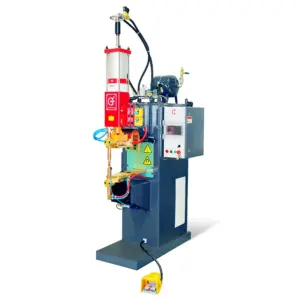
Modern projection welding systems such as those offered by Heron Welder include advanced programmable logic controllers (PLCs), graphical HMI interfaces, and digital power control. These features support automation integration, statistical process monitoring, and remote diagnostics.
Electrode & Fixture Design
Achieving consistent projection welds also requires careful fixture and electrode design. Customized tooling ensures reliable part positioning, uniform force distribution, and maximum repeatability.
Quality Assurance
Integrated sensors and feedback loops including real‑time current, force, and displacement monitoring enable engineers to embed quality checks into the process, reducing rework and scrap.
Best Practices for Projection Welding Success
To maximize weld quality and equipment uptime, consider these best practices:
Engineer Well‑Defined Projections
Projection height, shape, and spacing significantly affect resistance and heat concentration. Work with tooling specialists to fine‑tune projection design according to material and application.
Maintain Electrode Condition
Even though projection welding reduces electrode wear, scheduled maintenance including cleaning and re‑contouring keeps weld consistency high.
Optimize Weld Schedules
Empirically validate current, squeeze time, weld time, and hold time in controlled trials. Document optimal schedules for production repeatability.
Incorporate Real‑Time Process Monitoring
Leverage digital weld controllers with data capture to monitor trends and detect anomalies before they impact product quality.
Train Operators & Integrators
Well‑trained operators and integrators understand how to respond to weld alarms, make minor parameter adjustments, and maintain tooling ensuring uptime and product quality.
Why Choose Heron Welder for Projection Welding
As a global manufacturer of industrial welding and metal‑joining equipment, Heron Welder brings decades of experience engineering projection welders tailored for complex production environments. Our systems are designed for:
-
High reliability in demanding automotive, appliance, and industrial applications
-
Seamless factory automation integration, with advanced controls and data connectivity
-
Custom tooling and fixtures for unique part geometries
-
Robust support and training, ensuring your team gets the most from your investment
Whether you require standalone projection welders or fully automated welding lines, Heron’s solutions deliver precision, performance, and measurable ROI.
FAQs - Projection Welding
1. What materials can be welded with projection welding?
Projection welding works on a variety of conductive metals, including steel, stainless steel, aluminum alloys, and copper alloys, depending on system capacity and tooling.
2. Can projection welding join multiple parts at once?
Yes — one of its core advantages is the ability to weld multiple points simultaneously, increasing throughput.
3. How is projection welding different from spot welding?
Unlike spot welding, which creates single point welds, projection welding uses designed projections to localize heat at multiple points under a controlled current and force.
4. Do projection welders support automation systems?
Modern projection welders include PLC and HMI integration, making them ideal for automated production lines and Industry 4.0 environments.
5. How important is fixture design in projection welding?
Fixture design is critical. Precisely engineered fixtures ensure accurate part positioning, uniform force application, and repeatable weld quality.
Ready to Elevate Your Welding Process?
Projection welding offers speed, accuracy, and repeatability for high‑volume manufacturing. If you’re evaluating welding solutions for your production line, let’s talk.
Request a custom quote or consult with Heron Welder’s experts today to optimize your metal‑joining processes with tailored projection welding and automation solutions.