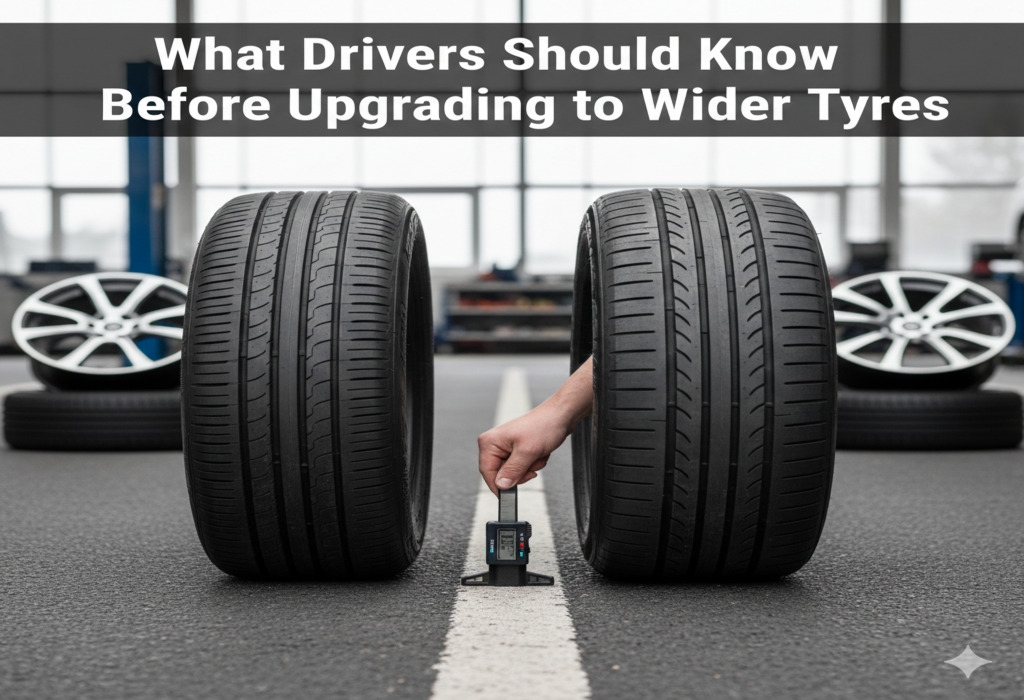

When the time comes to replace a set of tyres, many car owners in the UAE start thinking about more than just a direct replacement. The desire for a more aggressive stance, better cornering, or improved aesthetics often leads drivers to consider a wider tyres upgrade. This modification is one of the most popular ways to change a vehicle's character without investing in complex mechanical overhauls.
However, moving away from factory specifications is a decision that involves significant trade offs. While wider tyres can certainly enhance certain performance aspects, they also introduce new variables into your daily driving experience. From the way your car handles a sudden lane change on a Dubai highway to the amount of road noise you hear in the cabin, every millimeter of added width makes a difference.
This guide is designed to help you navigate the complexities of tyre sizing. We will look at how width affects your vehicle's dynamics, the impact on your wallet in terms of fuel and wear, and why regional factors like the UAE's heat play a critical role. Making an informed choice ensures that your upgrade enhances your driving pleasure rather than creating unexpected headaches.
Why Drivers Consider Switching to Wider Tyres
The most immediate reason many drivers seek a wider tyres upgrade is the visual transformation. A wider tyre fills out the wheel arches more effectively, giving the vehicle a "planted" and muscular appearance. For SUV and crossover owners in particular, this change can turn a standard commuter vehicle into something that looks far more capable and rugged.
Beyond the looks, there is the promise of improved mechanical grip. A wider tyre typically provides a larger contact patch—the area of rubber actually touching the road surface. In theory, more rubber on the road translates to better traction, especially during acceleration and hard braking. This is why high performance vehicles almost always feature wider tyres than their economy focused counterparts.
However, it is important to distinguish between the desire for a "cool look" and the actual needs of the vehicle. While a wider stance looks great in a parking lot, the reality of driving it every day through Sharjah city roads or on long commutes to Abu Dhabi requires a deeper understanding of the wider tyres pros and cons.
Performance and Visual Appeal Factors
From a performance standpoint, the primary benefit is lateral stability. When you take a corner, a wider tyre resists the tendency to "roll" onto its sidewall better than a narrow one might. This creates a sense of confidence and "flatness" during spirited driving. For drivers who enjoy the mountain roads of Jebel Jais or the sweeping curves of highway interchanges, this handling improvement is a major draw.
Visually, the wider stance changes the car's "offset" feel. It makes the vehicle appear lower to the ground and more stable. This aesthetic upgrade is often the first step in a broader project of vehicle modification UAE enthusiasts undertake to personalize their rides and stand out in a sea of factory standard cars.
Common Misconceptions About Wider Tyres
One common misconception is that wider tyres are always safer in all conditions. While they offer superior grip on dry, hot asphalt, their performance can vary in other scenarios. For instance, a wider tyre can actually be more prone to aquaplaning if you encounter standing water during a rare UAE rainstorm, as the tyre has a harder time "cutting through" the water.
Another myth is that wider tyres will automatically make any car faster. In reality, the increased width creates more aerodynamic drag and higher rolling resistance. Unless your car has the horsepower to overcome this extra friction, you might actually find that your top end acceleration is slightly blunted compared to the skinnier, more aerodynamic factory setup.
How Wider Tyres Affect Handling and Stability
The way a vehicle reacts to steering inputs is fundamentally tied to its tyre width. When you opt for a wider tyres upgrade, you are essentially recalibrating the interface between your car and the road. This change is most noticeable in the steering wheel, where you may feel a different level of resistance and feedback than you are used to.
The tyre width impact on driving is most evident during high speed maneuvers. Because there is more rubber resisting lateral forces, the car feels more connected to the ground. This "planted" feeling is a hallmark of performance tyres vs standard tyres, providing a level of stability that can make highway cruising feel more secure, even in the presence of strong crosswinds common in open desert areas.
However, this increased stability can sometimes come at the cost of agility. A very wide tyre can make the steering feel "heavy" at low speeds, such as when navigating tight parking garages in Dubai Marina. Understanding this balance is key to ensuring the upgrade matches your primary driving environment.
Cornering and Road Grip Improvements
In dry conditions, the handling improvement with wider tyres is undeniable. The larger surface area allows for better heat dissipation and a more consistent grip levels during prolonged cornering. This means that for the same corner, a wider tyre will likely reach its limit of adhesion much later than a narrower one.
This extra grip is not just for enthusiasts; it provides a safety margin. In an emergency swerve to avoid an obstacle on the E11, that extra bit of lateral traction can be the difference between maintaining control and entering a skid. The braking performance tyres offer is also generally superior in dry conditions, as the friction generated by the larger contact patch helps bring the vehicle to a halt more quickly.
Steering Feel and Control Changes
While grip increases, the "feel" of the steering often changes. Wider tyres tend to follow the contours of the road more closely a phenomenon known as "tramlining." If the road has ruts or grooves from heavy truck traffic, a wider tyre may try to "track" into those grooves, requiring more frequent steering corrections from the driver.
Additionally, the steering response might feel slightly dulled. Because it takes more force to turn a wider patch of rubber, the "snappiness" of the steering can decrease. This is something daily commuters should consider, as a car that was once light and flickable might become more of a chore to drive in heavy, stop and go traffic.
Impact of Wider Tyres on Ride Comfort and Noise
One of the most frequently overlooked aspects of a wider tyres upgrade is how it affects the refinement of the vehicle. Most factory fitted tyres are chosen because they offer a balance of quietness and vibration damping. When you move to a wider, performance oriented tyre, you are often moving toward a stiffer sidewall and a different tread pattern.
The ride comfort tyre width relationship is usually inverse. As tyres get wider, they often get lower in profile to maintain the correct overall diameter. A shorter sidewall has less "give," meaning more of the road’s imperfections are transmitted directly through the suspension and into the cabin. On the smooth sections of Abu Dhabi highways, this might not be an issue, but on older roads, the ride can become significantly firmer.
Road Surface Feedback and Ride Quality
A wider tyre acts like a more sensitive microphone for the road. You will feel small pebbles, cracks, and textures much more clearly. While driving enthusiasts call this "feedback," the average driver might find it tiring over long distances. If your daily commute involves uneven surfaces or construction zones, the increased vibration can lead to more rattles in the interior over time.
This firmness also places more stress on your suspension components. Bushings, shocks, and struts that were tuned for a soft, narrow tyre now have to work harder to dampen the sharper inputs from a wider, heavier wheel and tyre package. It is a classic example of how one modification can have a ripple effect throughout the vehicle's mechanical systems.
Tyre Noise Levels at City and Highway Speeds
Noise is another major factor. Wider tyres have more tread blocks in contact with the road, and the air trapped between these blocks creates a humming or roaring sound at high speeds. Modern performance tyres vs standard tyres use advanced "variable pitch" tread designs to minimize this, but a wider tyre will almost always be louder than a narrower one of the same model.
On a long drive from Dubai to Fujairah, this increased road noise can contribute to driver fatigue. It can also interfere with the car’s audio system or make hands free phone calls more difficult to hear. If cabin serenity is your priority, you must look for wider tyres specifically marketed for their low noise characteristics.
Fuel Efficiency and Wear Considerations
Every modification comes with a cost, and for wider tyres, that cost is often seen at the petrol pump. The fuel efficiency tyre size connection is straightforward physics: a wider tyre has more rolling resistance. It takes more energy from the engine to keep that larger patch of rubber rolling across the pavement.
For daily commute vehicles that cover 50 to 100 kilometers a day, even a small 3% to 5% drop in fuel economy can add up over a year. Additionally, wider tyres are generally heavier. This "unsprung weight" requires more energy to accelerate and more braking force to stop, further impacting the overall efficiency of the vehicle.
How Wider Tyres Influence Fuel Consumption
In the context of summer driving in the UAE, where the air conditioning is already straining the engine and the fuel system, the extra drag from wider tyres is more noticeable. The engine has to work harder to overcome the friction, which can lead to slightly higher operating temperatures.
While the individual impact might seem small, it is part of a cumulative effect. If you combine wider tyres with heavy aftermarket wheels, the impact on fuel consumption becomes even more pronounced. For drivers who are sensitive to rising fuel costs, this is perhaps the strongest argument for staying closer to the original factory width.
Tyre Wear Patterns and Replacement Frequency
Wider tyres are also susceptible to specific wear patterns. If your vehicle’s alignment is not perfectly adjusted for the new width, you may see rapid wear on the inner or outer edges of the tyre. Because there is more surface area, any misalignment is magnified.
Furthermore, performance oriented wider tyres are often made from softer rubber compounds to provide that extra grip. Softer rubber wears down faster than the harder, more durable compounds found on standard eco tyres. This means you might find yourself shopping for replacements more frequently, which is a significant factor in the long term cost of a wider tyres upgrade.
Choosing the Right Tyre Size for Your Vehicle
Navigating the world of tyre sizes can be confusing. You have to consider the width, the aspect ratio, and the rim diameter. When looking for a wider tyres upgrade, you cannot simply pick the widest tyre on the shelf; it must be compatible with your wheel width and the physical space inside your wheel wells.
For many SUV owners in the region, a common upgrade path involves finding a balance between rugged looks and highway manners. For example, moving to a size like 265 60 r18 tyres is a frequent choice for those who want a bit more "meat" on the wheels without completely ruining the car's factory tuned balance. This size offers a substantial footprint that works well on both the road and light sand, making it a versatile option for the UAE landscape.
It is vital to consult a wheel and tyre compatibility chart before making a purchase. A tyre that is too wide for the rim will have "bulging" sidewalls, which compromises handling and can even lead to the tyre popping off the rim under extreme stress. Conversely, a tyre that is too narrow for a wide rim will be "stretched," leaving the rim edge vulnerable to curb damage.
Understanding Manufacturer Recommended Sizes
Every vehicle is engineered with a specific range of tyre sizes in mind. These recommendations aren't just suggestions; they are based on the clearance needed for brake calipers, suspension arms, and the inner wheel arch during full steering lock. Staying within the manufacturer's "plus sizing" guidelines ensures that your safety systems, like ABS and Electronic Stability Control, continue to function as intended.
Modern cars rely on wheel speed sensors to manage traction. If you change the overall diameter of the tyre significantly while changing the width, you can confuse these sensors, leading to warning lights on the dashboard or unpredictable braking behavior.
Risks of Oversizing Beyond Specifications
The biggest risk of an aggressive wider tyres upgrade is "rubbing." This occurs when the tyre makes contact with the vehicle body or suspension components during bumps or tight turns. Rubbing can quickly slice into the tyre sidewall, leading to a catastrophic blowout.
There is also the issue of suspension geometry. Engineers spend years tuning a car's suspension to work with a specific tyre footprint. Moving to a much wider tyre can change the "scrub radius," which affects how the car tracks and how the steering wheel returns to center after a turn. In extreme cases, this can make the car feel nervous or "darty" at high speeds.
How UAE Driving Conditions Affect Wider Tyre Performance
The UAE presents a unique environment for rubber. The combination of extremely high ambient temperatures and the high speed nature of the highway network means that tyres are under constant thermal stress. When you choose a wider tyres upgrade, you need to consider how that extra width interacts with the heat.
Hot climate tyre performance is a critical safety topic. A wider tyre has a larger surface area to absorb heat from the scorching asphalt. During a summer afternoon in Dubai, road temperatures can exceed 60 degrees Celsius. While the larger surface area also helps dissipate heat, the internal friction of a wider tyre can actually lead to higher core temperatures if the pressures are not perfectly maintained.
Heat Resistance and Summer Driving Impact
In the summer driving UAE months, rubber becomes softer and more prone to rapid wear. A wider tyre, with its increased friction, can experience accelerated tread loss during this period. It is essential to choose tyres with a high "Temperature" rating (A is best) to ensure the compound can withstand the sustained thermal loads of high speed desert driving.
Additionally, the expansion of air inside the tyre is more significant in a wider tyre due to the larger volume of air. This makes regular pressure checks even more vital. An over inflated wide tyre will wear out the center of the tread very quickly and provide a very harsh ride.
City vs Highway Driving in Dubai and Sharjah
In the stop and go traffic of Sharjah city roads, the extra weight of wider tyres can make the car feel slightly more sluggish off the line. You may find yourself pressing the accelerator a bit harder to get the vehicle moving, which contributes to that increased fuel consumption we discussed earlier.
On the flip side, for Dubai highway driving, the stability of a wider tyre is a major benefit. When cruising at 120 km/h or 140 km/h, the increased footprint helps the car stay centered in its lane and provides a more relaxed steering feel during long stretches. For those who spend 80% of their time on the E11 or E311, the stability benefits often outweigh the city driving drawbacks.
Is Upgrading to Wider Tyres the Right Choice for You?
Deciding on a wider tyres upgrade ultimately depends on your priorities as a driver. There is no "perfect" tyre size, only the size that best fits your specific needs and driving environment. You must weigh the desire for better looks and dry grip against the realities of fuel costs and ride comfort.
If you are a driver who values the aesthetics of your vehicle and enjoys a firm, sporty feel, then a wider tyre is a fantastic modification. It transforms the look of the car and provides a tangible improvement in how the car handles corners. For many, this "fun factor" is well worth the extra cost at the pump.
Drivers Who Benefit Most From Wider Tyres
The drivers who benefit most are those with high performance SUVs or sedans who frequently drive on high speed highways. The added stability and braking performance provide a genuine safety benefit in these conditions. Furthermore, if you occasionally participate in track days or organized driving events, the extra grip is essential.
Those who have modified their vehicle's engine for more power will also find wider tyres necessary. If your engine is producing more torque than the standard tyres can handle, you will simply spin your wheels instead of moving forward. In this case, a wider tyres upgrade is a functional requirement to get that power to the ground.
Situations Where Standard Tyres Make More Sense
For the budget conscious daily commuter who prioritizes a soft ride and maximum fuel efficiency, staying with standard width tyres is usually the wiser choice. The factory engineers chose those tyres for a reason: they provide the most comfortable and economical experience for the widest range of drivers.
If you drive a small city car or a budget friendly sedan, the performance gains of wider tyres are often negligible, while the downsides in noise and fuel cost are immediately apparent. In these cases, it is better to invest in a higher quality tyre in the standard size rather than a wider tyre of lower quality.
Conclusion:
Upgrading the tyres on your vehicle is one of the most impactful changes you can make. A wider tyres upgrade offers a compelling mix of improved dry road handling, a more aggressive visual stance, and increased braking confidence. It can truly transform a mundane car into a vehicle that feels more premium and capable.
However, as we have explored, these benefits come with trade offs. You must be prepared for a slight increase in fuel consumption, a firmer ride, and potentially higher road noise. By staying within manufacturer recommended limits and considering the unique demands of the UAE climate, you can minimize these downsides and enjoy the benefits of your new setup.
Before you make the switch, take an honest look at your daily driving habits. Consult with a professional who understands wheel and tyre compatibility, and always prioritize quality over width. An informed, safety first approach will ensure that your new tyres don't just look good, but also perform reliably for thousands of kilometers to come.
FAQ Section
Do wider tyres always improve handling?
They generally improve dry road grip and cornering stability by providing a larger contact patch. However, they must be correctly sized for the rim and vehicle to avoid making the steering feel heavy or unresponsive.
Will wider tyres reduce fuel efficiency?
Yes, wider tyres increase rolling resistance and aerodynamic drag, which typically results in a slight increase in fuel consumption. This is most noticeable in stop and go city traffic and during high speed highway cruising.
Are wider tyres suitable for daily driving in UAE?
Yes, they are very popular in the UAE. As long as they are chosen within manufacturer specifications and have high temperature ratings, they can safely handle the heat and high speeds of local roads.
Can wider tyres affect ride comfort?
Yes, wider tyres often have stiffer sidewalls and can transmit more road noise and vibration into the cabin. This can result in a firmer ride that some drivers find less comfortable on uneven surfaces.