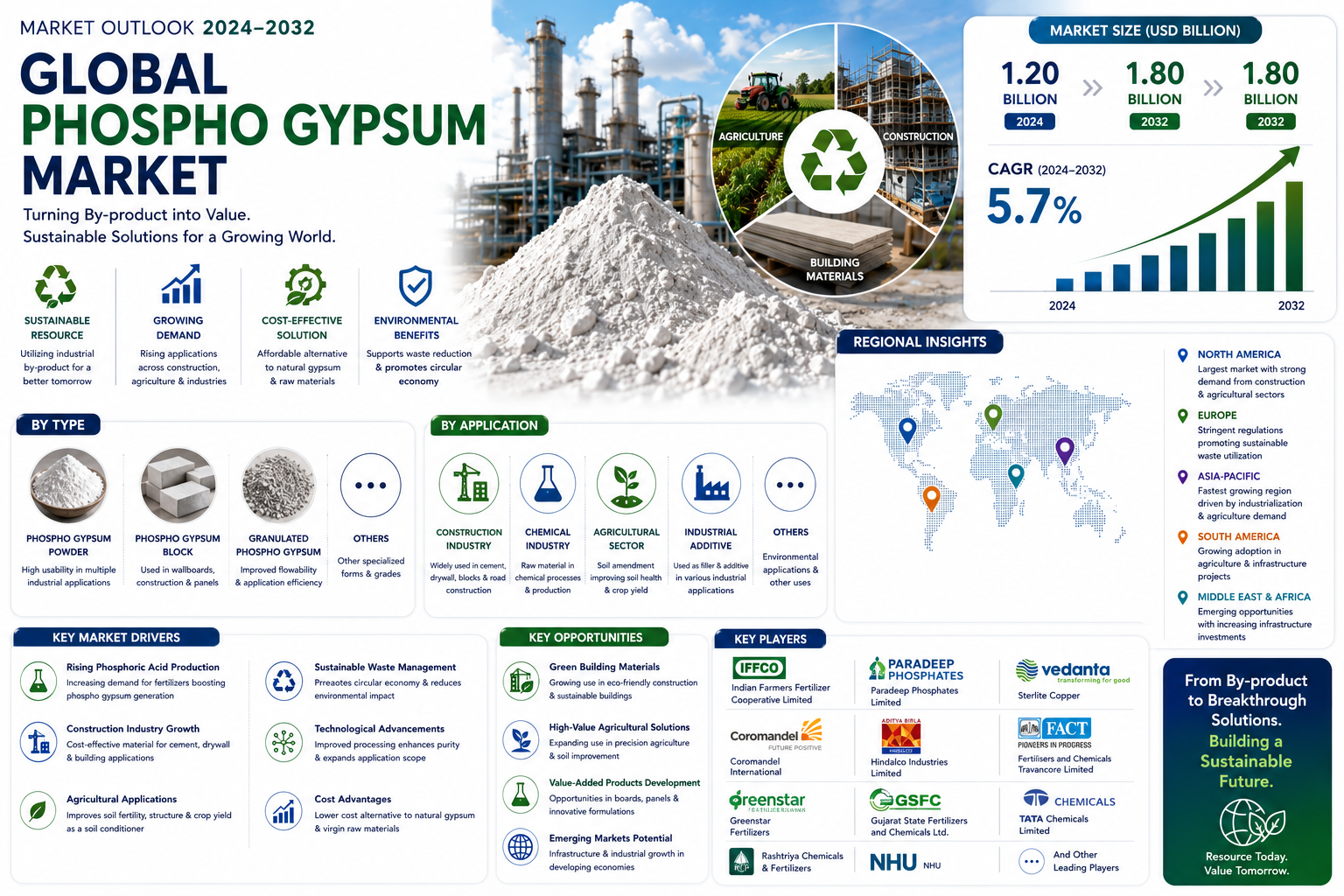
Global phospho gypsum market was valued at USD 1.2 billion in 2024 and is projected to reach USD 1.8 billion by 2032, growing at a CAGR of 5.7% during the forecast period.
Phospho gypsum is a byproduct of phosphoric acid production, primarily used in agricultural applications as a soil amendment and in construction materials. This calcium sulfate dihydrate material is generated during the wet process of phosphoric acid production, where phosphate rock is reacted with sulfuric acid. The material finds applications in cement production, soil conditioning, and as a filler in various industrial processes.
Market growth is driven by increasing demand for phosphoric acid in fertilizer production, particularly in developing agricultural economies. The construction industry's adoption of phospho gypsum as a cost-effective alternative to natural gypsum is another key growth factor. However, environmental concerns regarding heavy metal content and radioactivity in phospho gypsum may restrain market expansion. Key players are focusing on developing advanced processing technologies to improve product purity and expand application potential.
Download FREE Sample Report: https://www.24chemicalresearch.com/download-sample/291569/phospho-gypsum-market
Market Overview & Regional Analysis
The North American phosphogypsum market is primarily driven by the fertilizer and construction industries, particularly in the U.S. where phosphate fertilizer production generates significant by-product volumes. Approximately 40-50 million tons of phosphogypsum are produced annually in the U.S. alone, though stringent EPA regulations under the Resource Conservation and Recovery Act limit its commercial use due to radioactive content concerns. However, recent research into safe applications, particularly in road construction and soil amendments, is creating new opportunities. The region shows growing interest in recycling phosphogypsum for sustainable cement production, aligning with broader environmental initiatives.
Europe presents a more regulatory-driven market, with strict EU waste management directives governing phosphogypsum utilization. Countries like Spain and Belgium, with active phosphate fertilizer industries, are leading in developing closed-loop systems where over 70% of by-product gypsum finds reuse in construction materials and soil stabilization. The European Commission's push for circular economy practices is accelerating innovation in processing technologies to reduce heavy metal content. Germany, in particular, has seen success in using treated phosphogypsum for drywall manufacturing, though concerns about long-term environmental impacts continue to influence policy decisions.
As the fastest-growing regional market, Asia-Pacific dominates phosphogypsum production volumes, with China contributing over 60% of global output through its massive phosphate fertilizer sector. While historically plagued by storage challenges and environmental incidents, the region is increasingly adopting better waste management practices. India's agricultural expansion and construction boom are driving demand for both phosphogypsum blocks in affordable housing and powdered forms for soil conditioning. Southeast Asian nations are exploring applications in coastal infrastructure projects, leveraging the material's water-resistant properties. However, inconsistent quality standards across countries remain a market restraint.
Brazil's agricultural sector fuels phosphogypsum production in the region, with the material widely used as calcium sulfate fertilizer in soybean and sugarcane cultivation. The Brazilian Association of Fertilizer Diffusion estimates 3-4 million tons annual consumption for agricultural applications alone. While lacking robust regulatory frameworks compared to developed markets, countries like Argentina and Colombia are beginning to formalize guidelines for phosphogypsum use in construction materials. Economic fluctuations sometimes disrupt the supply-demand balance, but the region demonstrates steady growth potential through value-added product development in cement and soil remediation sectors.
This emerging market shows divergent trends - while North African nations like Morocco and Tunisia leverage abundant phosphate rock reserves to produce phosphogypsum for export markets, Gulf Cooperation Council countries focus on utilizing imports for specialty construction applications. Saudi Arabia's Vision 2030 infrastructure projects have incorporated phosphogypsum-based panels in some developments. Sub-Saharan Africa faces storage and handling challenges, though pilot projects in South Africa demonstrate viable uses in mine rehabilitation. The region's growth trajectory will depend on technology transfers and environmental management improvements in coming years.
Key Market Drivers and Opportunities
Global construction industry's robust growth is accelerating demand for phospho gypsum as a key building material. This byproduct of phosphate fertilizer production is increasingly valued as a sustainable alternative to natural gypsum in drywall, cement retarders, and soil stabilization applications. With the construction market projected to reach $15 trillion by 2030, the push for cost-effective and eco-friendly materials positions phospho gypsum as a strategic resource. Emerging economies in Asia-Pacific are driving particularly strong demand, where rapid urbanization and infrastructure development require massive quantities of construction materials.
Phospho gypsum is gaining traction as a soil amendment in agricultural applications due to its high calcium and sulfur content. Farmers globally are adopting this byproduct to improve soil structure, reduce erosion, and enhance crop yields. The agriculture sector's focus on sustainable practices and the need for affordable soil conditioners in developing regions create significant growth opportunities. Recent studies demonstrate yield improvements of 15-20% in sulfur-deficient soils when treated with phospho gypsum, making it increasingly attractive for large-scale farming operations. Furthermore, regulatory support for sustainable farming practices and waste utilization in agriculture is creating favorable conditions for market expansion. Governments worldwide are implementing policies to promote circular economy principles in agriculture, where phospho gypsum plays a vital role in repurposing industrial byproducts.
Emerging purification and processing technologies are expanding potential applications for phospho gypsum. Recent advancements in washing and chemical treatment processes can reduce impurity levels and radioactivity, potentially allowing access to previously restricted markets. Several companies are investing in research to develop high-purity phospho gypsum products suitable for food-grade and pharmaceutical applications, which could significantly expand market potential. Additionally, growing interest in circular economy principles is driving investment in phospho gypsum utilization. Major fertilizer producers are forming strategic partnerships with construction material companies to develop integrated waste-to-resource operations. These collaborations aim to transform phospho gypsum from a disposal challenge into a value-added product, creating new revenue streams while addressing environmental concerns. The push for sustainable building materials in green construction projects presents another significant opportunity. As certification programs like LEED gain prominence, architects and developers are increasingly seeking recycled content materials that can contribute to sustainability credits, positioning processed phospho gypsum as an attractive option.
Challenges & Restraints
Despite its economic benefits, phospho gypsum faces significant regulatory hurdles due to trace radioactivity from its phosphate rock origin. Many countries impose strict limitations on its use, particularly in residential construction, creating market barriers. The material typically contains radium-226 which decays into radon gas, leading to potential health concerns. Current regulations in several developed markets prohibit the widespread use of phospho gypsum in building materials, restricting its application primarily to agricultural and industrial uses. The varying regulatory landscape across regions creates additional complexities for market participants. While some countries have established clear guidelines for safe usage, others maintain complete bans, forcing producers to carefully navigate compliance requirements. This regulatory fragmentation presents challenges for companies seeking to expand operations across multiple markets with different standards.
The phospho gypsum market faces substantial logistical challenges due to the material's bulk nature and weight. Transportation costs can account for up to 40% of total product costs, making regional accessibility a critical factor in market development. Many fertilizer production facilities are located far from key consumption areas, creating significant supply chain inefficiencies. These logistical hurdles particularly affect smaller operations that lack the infrastructure for cost-effective distribution. The chemical composition of phospho gypsum can vary significantly depending on the phosphate rock source and production process. This inconsistency presents challenges for end-users requiring uniform material characteristics, particularly in precision agricultural and construction applications. While phospho gypsum is valued as a byproduct utilization solution, its storage and handling raise environmental concerns. Improper stacking can lead to water contamination and dust emissions, requiring producers to implement robust environmental management systems.
Market Segmentation by Type
● Phospho Gypsum Powder
● Phospho Gypsum Block
● Granulated Phospho Gypsum
● Others
Phospho Gypsum Powder leads the market due to its high applicability across industries.
Download FREE Sample Report: https://www.24chemicalresearch.com/download-sample/291569/phospho-gypsum-market
Market Segmentation by Application
● Construction Industry
● Chemical Industry
● Agricultural Sector
● Others
Construction Industry dominates due to widespread use in cement manufacturing and wallboard production.
Market Segmentation and Key Players
● Indian Farmers Fertilizer Cooperative Limited (India)
● Paradeep Phosphates Limited (India)
● Sterlite Copper (India)
● Coromandel International (India)
● Hindalco Industries Limited (India)
● Fertilisers and Chemicals Travancore Limited (India)
● Greenstar Fertilizers (India)
● Gujarat State Fertilizers and Chemicals Ltd (India)
● TATA Chemicals Limited (India)
● Rashtriya Chemicals & Fertilizers (India)
Report Scope
This report presents a comprehensive analysis of the global and regional markets for Phospho Gypsum, covering the period from 2024 to 2032. It includes detailed insights into the current market status and outlook across various regions and countries, with specific focus on:
● Sales, sales volume, and revenue forecasts
● Detailed segmentation by type and application
The report features in-depth competitive intelligence including:
● Market share analysis of leading manufacturers
● Production capacity expansions
● Product portfolio assessments
● Strategic partnership evaluations
Our research methodology combines primary interviews with industry leaders and comprehensive data analysis of:
● Production facilities and their geographical distribution
● Raw material sourcing patterns
● End-user industry consumption trends
● Regulatory impact assessments
Get Full Report Here: https://www.24chemicalresearch.com/reports/291569/global-aluminum-plate-sheet-market
About 24chemicalresearch
Founded in 2015, 24chemicalresearch has rapidly established itself as a leader in chemical market intelligence, serving clients including over 30 Fortune 500 companies. We provide data-driven insights through rigorous research methodologies, addressing key industry factors such as government policy, emerging technologies, and competitive landscapes.
● Plant-level capacity tracking
● Real-time price monitoring
● Techno-economic feasibility studies
With a dedicated team of researchers possessing over a decade of experience, we focus on delivering actionable, timely, and high-quality reports to help clients achieve their strategic goals. Our mission is to be the most trusted resource for market insights in the chemical and materials industries.
International: +1(332) 2424 294 | Asia: +91 9169162030
Website: https://www.24chemicalresearch.com/
Follow us on LinkedIn: https://www.linkedin.com/company/24chemicalresearch