What Packaging Protects Contents from Yonoel's Roadside Car First Aid Kit Factory
What Are the Most Common Sizes and Packaging Options Offered by a Roadside Car First Aid Kit Factory?
Automotive retailers, procurement officers, and emergency supply distributors frequently confront a practical sourcing decision when selecting roadside emergency products, yet the physical dimensions and outer wrapping of these kits carry implications that extend far beyond simple aesthetics. A compact kit may fit conveniently into a glove compartment but lack sufficient capacity for essential trauma supplies, while an oversized case might contain comprehensive contents but prove impractical for everyday vehicle storage. Yonoelfirstaid, operating through Dongyang City Yonoel Outdoor Products Co., Ltd., has produced and packaged thousands of configurations from its specialized Roadside Car First Aid Kit Factory, observing how size and packaging directly influence buyer satisfaction and end-user adoption. The central question that emerges from this production experience remains: what are the standard size ranges and packaging forms that a professional factory most frequently supplies to global automotive and retail clients?
The size spectrum of roadside car first aid kits typically spans three principal categories, each serving distinct vehicle types and user expectations. The smallest configuration, often termed a personal or glove-compartment kit, occupies dimensions roughly equivalent to a thick paperback book, measuring approximately 15 by 10 by 5 centimeters. These compact kits contain bare essentials—adhesive bandages, antiseptic wipes, a small gauze pad, and perhaps a single cold pack—and suit drivers who prioritize minimal space consumption over comprehensive preparedness. Mid-range kits, the most commonly ordered size from Yonoel's Roadside Car First Aid Kit Factory, feature dimensions around 20 by 15 by 8 centimeters, accommodating supplies for multiple trauma scenarios while still fitting under car seats or in side-door storage bins. These kits include trauma shears, multiple dressing sizes, adhesive tape, burn dressings, and a CPR mask, addressing the majority of road incident requirements. The largest kits, often specified for SUVs, commercial fleets, or off-road vehicles, measure approximately 30 by 20 by 15 centimeters and contain extensive item sets including tourniquets, chest seals, emergency blankets, and splinting materials, providing field-level treatment capability for severe injuries.
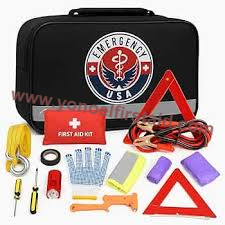
Packaging options from a Roadside Car First Aid Kit Factory fall into several distinct categories, each serving different market segments and usage contexts. Soft-sided nylon or polyester pouches represent the most common packaging form, offering durability, water resistance, and flexible shape adaptation for tight storage spaces. These fabric cases typically feature color-coded compartments, transparent windows for quick item identification, and MOLLE attachment systems that enable mounting to vehicle interior surfaces. Yonoel's Roadside Car First Aid Kit Factory produces soft packs in various colors and custom-branded designs, accommodating private label requirements from automotive manufacturers and promotional product distributors. The soft-pack construction allows for lightweight transport and easy handling during emergency use, where heavy protective cases might prove cumbersome.
Hard-shell plastic cases constitute the second major packaging category, providing superior impact protection and internal organization through custom-molded inserts. These cases often incorporate secure latches, carrying handles, and watertight seals that protect contents from moisture and dust accumulation during extended vehicle storage. Pharmaceutical and medical device companies frequently specify hard cases for kits containing temperature-sensitive supplies or glass ampoules, as the rigid exterior guards against compression damage. Yonoel's Roadside Car First Aid Kit Factory offers hard-case options with varied internal configurations, including removable trays that enable tiered organization and rapid access to critical items without disturbing the entire kit contents. The hard case format particularly appeals to government procurement contracts and commercial fleet operators who require standardized, easily inventoried emergency equipment.
Material choices within each packaging category further differentiate product offerings. For soft packs, the selection between 300-denier and 1000-denier nylon affects abrasion resistance, weight, and cost, with higher denier fabrics providing extended durability for professional use. Polyester alternatives offer colorfastness and resistance to UV degradation, an important consideration for kits stored on vehicle rear shelves exposed to sunlight. Yonoel's Roadside Car First Aid Kit Factory sources materials that balance durability with cost-effectiveness, ensuring that packaging longevity matches the typical replacement cycle of the kit contents. This material selection process involves testing for seam strength, zipper performance, and handle attachment reliability, preventing premature failure that could scatter critical supplies during retrieval.
The internal packaging configuration of each kit also follows common factory patterns. Some designs utilize color-coded pouches within the main case, dividing contents into wound care, medication, and diagnostic sections for intuitive access during stressful situations. Other configurations employ transparent vinyl pockets that present each item individually, reducing search time when seconds count. Yonoel's Roadside Car First Aid Kit Factory commonly produces kits with clearly labeled compartments that assist users with limited first-aid training, as confusion during emergencies often compounds the severity of incidents. The internal arrangement of supplies directly influences how quickly responders can locate and deploy essential tools.
Specific size and packaging combinations address particular market requirements. European automotive regulations often specify compact kit dimensions that fit within designated storage compartments in vehicle interiors, while Australian and North American clients frequently prefer larger kits with comprehensive contents for extensive highway travel. Yonoel's Roadside Car First Aid Kit Factory adapts its size and packaging offerings to these regional preferences, maintaining tooling for multiple case designs that accommodate diverse regulatory standards and user expectations. This flexibility enables procurement consolidation, where clients purchase standardized kits for global operations without requiring factory retooling for each market.
For buyers evaluating these size and packaging options against their specific needs, the detailed product information accessible through https://www.yonoelfirstaid.com/product/roadside-emergency-kit/ demonstrates how Yonoel's Roadside Car First Aid Kit Factory translates standard dimension and packaging categories into tangible product variants, with specifications that facilitate direct comparison. This resource supports informed sourcing decisions by presenting actual case measurements, material descriptions, and capacity details that correspond to production capabilities. The visible product range confirms that the factory maintains broad flexibility within established size and packaging frameworks.
The practical implications of size and packaging selection extend beyond immediate storage convenience. Properly sized kits increase the likelihood that vehicle occupants will retain the kit in its designated location rather than removing it due to space constraints. Durable packaging protects supplies from temperature extremes and humidity fluctuations that accelerate component degradation, preserving kit effectiveness over its intended shelf life. Yonoel's Roadside Car First Aid Kit Factory addresses these usage realities through iterative design refinements that incorporate feedback from fleet managers, automotive engineers, and emergency medicine professionals. The resulting size and packaging standards represent cumulative industry experience rather than arbitrary specifications.
Ultimately, the most common sizes and packaging options from a professional Roadside Car First Aid Kit Factory reflect the balance between portability, content capacity, and protective function. Yonoel supplies these configurations as standard offerings while accommodating custom adjustments for volume clients with specific branding or spatial constraints. The range of available choices enables buyers to match kit characteristics precisely to their target vehicle models and user demographics, ensuring that the final product serves its purpose without compromise. Does your procurement specification account for all these dimensional and packaging variables?