Automotive Paints Market: Regional Growth Analysis Across Asia Pacific, Europe, and North America
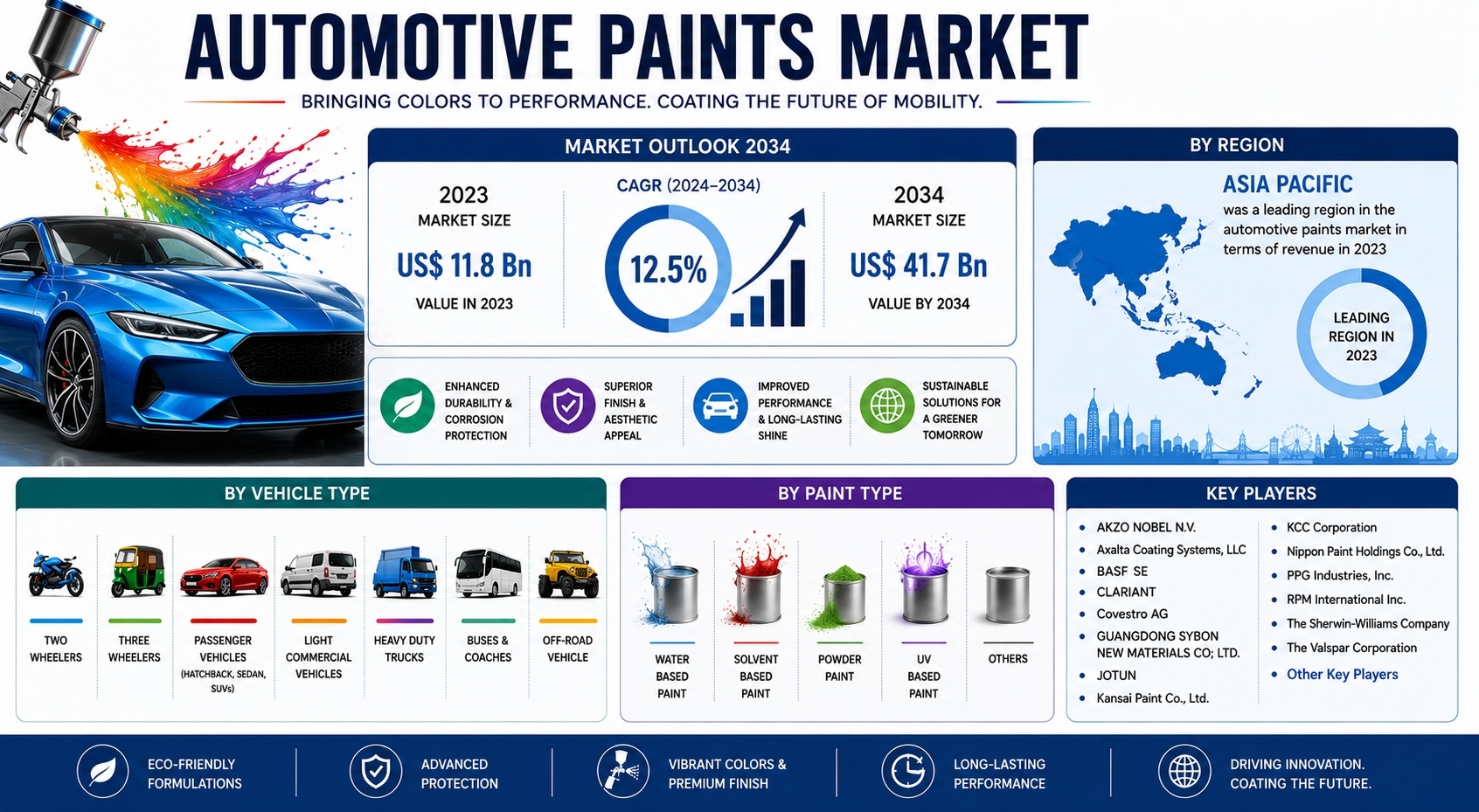
The global automotive industry continues to evolve rapidly, driven by electrification, sustainability goals, digital manufacturing, and changing consumer expectations. As vehicle production expands and automotive technologies become more sophisticated, the automotive paints market is emerging as one of the most dynamic sectors within the global coatings industry. Automotive paints play a vital role in enhancing vehicle aesthetics while also protecting surfaces from corrosion, abrasion, ultraviolet radiation, chemical exposure, and environmental degradation.
Automotive coatings are no longer limited to decorative functions. Modern paints contribute significantly to vehicle durability, thermal performance, energy efficiency, and environmental compliance. Manufacturers are increasingly adopting advanced coating technologies such as water-based paints, powder coatings, UV-curable coatings, smart coatings, and self-healing systems to meet evolving market demands.
The global automotive paints market was valued at US$ 11.8 billion in 2023 and is projected to reach US$ 41.7 billion by 2034, expanding at a robust CAGR of 12.5% from 2024 to 2034. While growth is occurring worldwide, regional dynamics vary significantly depending on automotive production, regulatory environments, technology adoption, and consumer preferences.
Among all regions, Asia Pacific dominates the market, while Europe leads in sustainable innovation and North America remains a key hub for advanced coatings and aftermarket demand. Understanding these regional differences is essential for manufacturers, suppliers, and investors seeking growth opportunities in the automotive paints industry.
Global Overview of Regional Market Dynamics
Regional demand for automotive paints is shaped by several critical factors:
-
Vehicle production volumes
-
Passenger car ownership
-
Commercial vehicle demand
-
Electric vehicle adoption
-
Environmental regulations
-
Manufacturing investments
-
Consumer color preferences
-
Technological innovation
Regions with strong automotive manufacturing bases naturally consume larger volumes of coatings. However, regions focused on premium vehicles or EV production often generate higher demand for specialized high-value coatings.
The automotive paints value chain also differs by geography. Some regions are dominated by OEM demand, while others show strong aftermarket refinishing markets.
These regional distinctions influence coating formulations, color trends, texture preferences, and application technologies.
Asia Pacific: The Dominant Regional Market
Asia Pacific is the largest and fastest-growing region in the global automotive paints market.
The region accounted for the leading share in 2023 and is expected to maintain dominance through 2034.
Several factors contribute to Asia Pacific’s leadership:
Massive Vehicle Production
Asia Pacific houses some of the world’s largest automotive manufacturing hubs.
Major vehicle-producing countries include:
-
China
-
Japan
-
South Korea
-
India
-
Thailand
These countries produce millions of vehicles annually, driving substantial paint demand.
Every manufactured vehicle requires multiple layers of coatings for interior and exterior components, making production volume a major demand driver.
Electric Vehicle Leadership
Asia Pacific leads global EV production and adoption.
China alone contributes a major share of global electric vehicle sales. The country has aggressively promoted EV manufacturing through subsidies, industrial policy, and charging infrastructure expansion.
Electric vehicles require advanced coatings for:
-
Lightweight materials
-
Battery enclosures
-
Thermal management
-
Energy efficiency
This boosts demand for specialized automotive coatings.
Rising Middle-Class Consumer Base
Growing disposable incomes across emerging Asian economies are increasing vehicle ownership.
Rapid urbanization and infrastructure development are further accelerating automobile demand.
Consumers increasingly prefer:
-
Premium aesthetics
-
Metallic finishes
-
Scratch-resistant coatings
-
Durable finishes
These preferences create opportunities for advanced paint technologies.
Manufacturing Cost Advantages
Asia Pacific remains attractive due to:
-
Lower labor costs
-
Strong supply chains
-
Industrial clusters
-
Raw material access
Many global paint manufacturers continue expanding operations in the region.
China: The Largest National Market
China is the single largest contributor to the automotive paints market.
China’s leadership stems from:
Largest Vehicle Production Base
China produces more vehicles than any other country.
EV Manufacturing Leadership
The country dominates EV manufacturing globally.
Government Support
Industrial policies encourage advanced automotive manufacturing.
Technology Adoption
Chinese OEMs increasingly adopt innovative coatings.
Demand for:
-
Water-based paints
-
Solar-reflective coatings
-
Smart coatings
-
Sustainable paint systems
is growing rapidly.
China remains a major growth engine for global paint manufacturers.
India: Emerging Growth Hub
India is becoming one of the most attractive growth markets.
Key growth drivers include:
-
Rising passenger car sales
-
Expanding two-wheeler demand
-
Infrastructure growth
-
Growing EV ecosystem
-
Government manufacturing initiatives
India’s automotive sector continues expanding across:
-
Passenger vehicles
-
Commercial vehicles
-
Two-wheelers
-
Three-wheelers
As vehicle production rises, automotive coating demand grows accordingly.
The market is also shifting toward sustainable coatings due to stricter environmental regulations.
Japan and South Korea
Japan and South Korea remain critical markets due to technological sophistication.
These countries lead in:
-
High-quality coatings
-
Precision manufacturing
-
Advanced robotics
-
Premium vehicle production
Automakers demand highly durable coatings with exceptional finish quality.
Innovation in smart coatings and specialty textures remains strong.
Europe: Sustainability and Premium Innovation Leader
Europe is a highly important region in the automotive paints market.
Although production volumes are lower than Asia Pacific, Europe generates high-value coating demand.
The region is known for:
-
Luxury automotive brands
-
Strong R&D investment
-
Sustainability leadership
-
Strict emissions regulations
European automotive manufacturing emphasizes quality, sustainability, and premium aesthetics.
Strong Environmental Regulations
Europe has some of the world’s strictest emissions regulations.
These policies significantly affect paint manufacturing.
Regulations focus on reducing:
-
VOC emissions
-
Carbon footprint
-
Hazardous chemicals
-
Industrial waste
This has accelerated adoption of:
-
Water-based paints
-
Powder coatings
-
UV-curable coatings
-
Biomass-based coatings
European automakers increasingly prioritize environmentally friendly suppliers.
This drives coating innovation across the region.
Premium Automotive Production
Europe is home to many premium vehicle manufacturers.
Luxury and performance vehicles demand advanced coatings offering:
-
Deep gloss
-
Metallic brilliance
-
Pearlescent effects
-
Matte luxury finishes
-
High durability
Premium vehicles often require custom paint formulations.
This increases demand for specialized coatings with higher margins.
Luxury coatings frequently include anti-scratch and self-healing capabilities.
EV Transition in Europe
Europe is rapidly transitioning toward electric mobility.
Many countries are targeting reduced internal combustion engine sales over the next decade.
This transition creates demand for:
-
Battery protection coatings
-
Lightweight substrate coatings
-
Thermal management coatings
-
Sustainable paint systems
EV-focused innovation is a major growth driver.
Countries leading adoption include:
-
Germany
-
France
-
United Kingdom
-
Norway
Europe remains a key innovation center for next-generation coatings.
Germany: Innovation Powerhouse
Germany is Europe’s automotive manufacturing leader.
The country excels in:
-
Premium vehicles
-
Engineering excellence
-
Coating innovation
-
Sustainable manufacturing
German automakers increasingly collaborate with coating companies to develop advanced paint systems.
Collaborations involving BASF and BMW Group highlight this trend.
Germany will remain critical to automotive coating innovation.
North America: Advanced Manufacturing and Aftermarket Strength
North America remains a major market for automotive paints.
The region benefits from:
-
Large vehicle sales
-
Strong aftermarket demand
-
Advanced manufacturing
-
High-performance vehicle segments
Key countries include:
-
United States
-
Canada
-
Mexico
North America has a strong presence in both OEM and aftermarket segments.
SUV and Pickup Truck Demand
The region has strong consumer demand for:
-
SUVs
-
Pickup trucks
-
Large commercial vehicles
These vehicle types require high-durability coatings due to:
-
Harsh weather exposure
-
Heavy usage
-
Off-road conditions
Demand for rugged protective coatings is high.
This supports growth in premium performance coatings.
Strong Aftermarket Industry
North America has one of the world’s largest automotive refinishing markets.
Aftermarket demand includes:
-
Collision repair
-
Repainting
-
Custom finishes
-
Restoration projects
Refinishing coatings contribute significantly to market revenue.
Custom automotive paint culture is especially strong in the United States.
Specialty finishes such as:
-
Matte black
-
Metallic chrome
-
Pearlescent effects
-
Custom graphics
remain popular.
United States Market
United States leads regional demand.
Growth is supported by:
Strong Vehicle Ownership
High car ownership drives coating demand.
Large Aftermarket Sector
Repair and refinishing demand remains strong.
EV Growth
Increasing EV adoption boosts advanced coating demand.
Innovation Investment
Manufacturers continue adopting smart paint technologies.
The U.S. remains highly attractive for premium coatings.
Regional Competition Landscape
Global coating leaders compete aggressively across all major regions.
Leading companies include:
-
Akzo Nobel
-
Axalta
-
BASF
-
Clariant
-
Covestro
-
Jotun
-
Kansai Paint
-
KCC Corporation
-
Nippon Paint
-
PPG Industries
-
RPM International
-
Sherwin-Williams
-
Valspar
Regional expansion strategies include:
-
New manufacturing plants
-
OEM partnerships
-
R&D centers
-
Product localization
Competition is increasingly driven by innovation and sustainability.
Future Regional Outlook Through 2034
Regional growth patterns will continue evolving.
Expected trends include:
Asia Pacific
-
Fastest volume growth
-
Strong EV dominance
-
Manufacturing expansion
Europe
-
Sustainability leadership
-
Premium coating innovation
-
Strong regulatory influence
North America
-
High-value coatings
-
Strong refinishing market
-
Smart manufacturing growth
Each region offers distinct opportunities.
Manufacturers that align product innovation with regional demand will gain the strongest competitive advantage.
