What Specifications Can You Expect from Zepopump's Double Diaphragm Pump Manufacturer on AODD Models

Selecting an air-operated double-diaphragm pump requires matching its flow and pressure capabilities to the application demands. Flow rate determines how quickly fluid moves through the system, while discharge pressure dictates how far or high the pump can push that fluid. These two parameters define the pump's operating envelope, influencing pipe sizing, power requirements, and overall process efficiency. Buyers frequently ask about maximum achievable performance, yet actual delivery depends on numerous factors including air supply pressure, fluid viscosity, suction conditions, and discharge head. Understanding these relationships helps engineers specify appropriate equipment. So what maximum flow rate and discharge pressure can a Double Diaphragm Pump Manufacturer actually achieve with AODD pumps, and how does zepopump from ZhanBo address these performance specifications?
The theoretical performance of an AODD pump derives from its displacement volume per stroke and operating speed. Each complete stroke moves a fixed fluid volume from the inlet through the chamber to the discharge. Multiplying this volume by the strokes per minute yields the nominal flow rate. Discharge pressure comes from the air pressure applied to the opposite side of the diaphragms, multiplied by the area ratio between the air piston and the fluid chamber. A pump with a 1:1 ratio delivers discharge pressure equal to air supply pressure, while a 2:1 ratio doubles the output pressure at the expense of lower flow. This trade-off between flow and pressure shapes the pump performance curve.
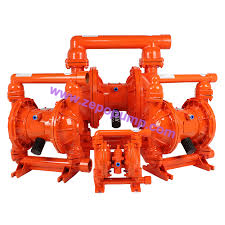
Practical flow rates for standard AODD pumps from a Double Diaphragm Pump Manufacturer span a considerable range. Small models with half-inch connections may deliver up to several gallons per minute, suitable for sampling, dosing, or small transfer tasks. Larger pumps with three-inch or four-inch ports can produce hundreds of gallons per minute, moving fluid through substantial pipelines. The maximum flow typically occurs at low discharge pressure, diminishing as back pressure increases. This characteristic resembles a fan curve: high flow at low resistance, low flow at high resistance. The pump operates anywhere along this curve depending on system conditions.
Discharge pressure capability similarly varies across models. Most industrial AODD pumps generate pressures up to approximately 8.6 bar (125 psi) with standard air supplies. Some designs extend to 12 bar (175 psi) with enhanced seals and diaphragms. Higher pressures require greater air consumption, larger air valves, and reinforced components. A Double Diaphragm Pump Manufacturer must balance pressure capability against durability, cost, and reliability. Zepopump applies engineering expertise to define these parameters for each model, selecting diaphragms, valve materials, and seal configurations suited to the pressure envelope.
Air supply quality impacts achievable performance significantly. Moisture, oil, or particulate contamination in compressed air can damage diaphragms, clog pilot valves, and reduce cycling speed. Maintaining dry, filtered air at adequate volume ensures the pump reaches its rated flow and pressure. Many AODD pump installations include air preparation units with filters, regulators, and lubricators to protect the pump and optimize performance. Zepopump recommends such accessories as part of the complete pumping solution.
Fluid characteristics modify the pump's effective performance. Viscous fluids reduce cycling speed because the diaphragms encounter resistance during the suction stroke. Higher viscosity also increases pressure drop through the discharge line, requiring higher discharge pressure to maintain flow. The pump's displacement capacity remains constant, but actual throughput depends on how quickly the fluid can fill the chambers. A Double Diaphragm Pump Manufacturer provides viscosity correction factors to predict real-world performance with sticky, thick materials.
Suction conditions impose another limit on AODD performance. The pump creates vacuum on the inlet side to draw fluid upward. Maximum suction lift depends on atmospheric pressure, fluid vapor pressure, and hose diameter. Higher elevation sites reduce available suction lift due to lower atmospheric pressure. Cavitation, a condition where fluid flashes to vapor in the suction line, limits performance and damages components. Maintaining adequate suction pressure and proper inlet pipe sizing prevents these problems, allowing the pump to achieve its specified flow and pressure.
Application examples illustrate performance requirements. A chemical plant transferring adhesive from a storage drum to a day tank may need 20 gallons per minute at 3 bar pressure. A mine dewatering operation might require 150 gallons per minute against 5 bar discharge head. A food processing facility pumping fruit puree seeks gentle flow at moderate pressure to preserve product integrity. Each application matches to a specific model within the Double Diaphragm Pump Manufacturer product range. Zepopump engineering supports these selections through comprehensive performance data and application guidance.
The product range from Zepopump covers these diverse requirements with AODD pumps constructed from various wetted materials. Stainless steel serves corrosive and sanitary applications, polypropylene handles chemical exposures, and aluminum offers cost-effective general service. Each material choice affects flow and pressure ratings slightly due to weight and surface finish differences. The company provides detailed performance curves showing flow against pressure for every model, enabling accurate specification. Visit https://www.zepopump.com/product/ to access these technical resources and select the AODD pump matching your flow and pressure needs.