The Ultimate Guide to Precision Marking Tools: Boost Your Workshop Accuracy
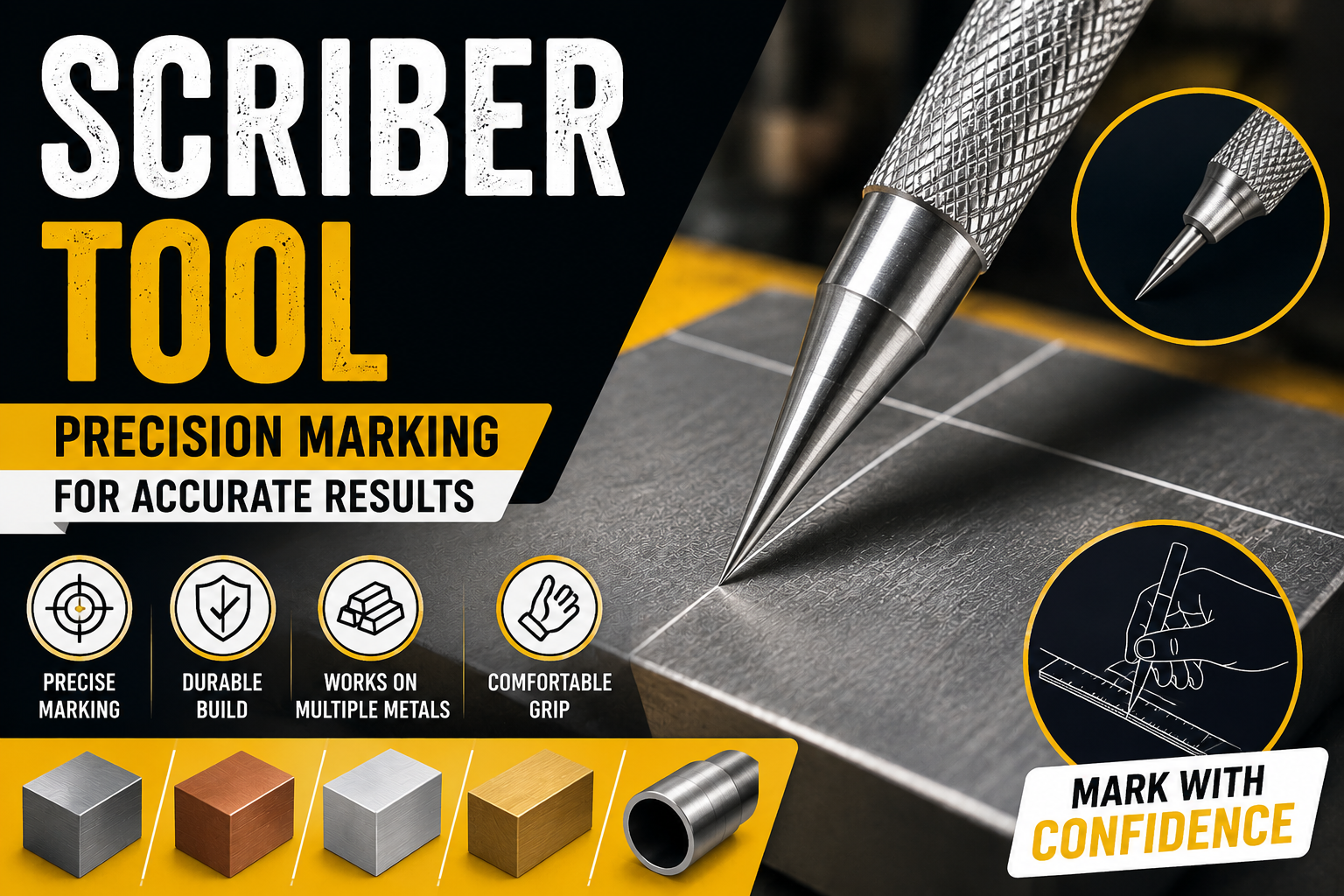
Whether you're a seasoned machinist, a hobbyist woodworker, or someone who just started exploring metalworking, one thing becomes clear very quickly — pencils and markers simply don't cut it when precision matters. Smudged lines, faded marks, and inaccurate cuts can ruin a project that took hours to set up. That's where hardened marking instruments come in, and understanding them properly can genuinely change the quality of your work.
What is a Precision Marking Hand Tool?
A precision marking hand tool is a sharp, pointed instrument made from extremely hard materials — typically hardened steel or tungsten carbide — designed to scratch thin, accurate guide lines onto hard surfaces like metal, glass, ceramics, and wood. Unlike a pencil, which deposits a soft graphite layer that can smear or rub away, these tools physically engrave a fine groove into the material's surface. The result is a mark that stays exactly where you put it, no matter how much handling the workpiece goes through before cutting or assembling.
These tools are used before cutting, grinding, drilling, or machining to ensure every measurement translates into a perfectly visible, permanent guideline on the workpiece.
Why Precision Tools Outperform Pencils and Markers
This is the question beginners often ask: "Why can't I just use a marker?"
Here's the honest answer:
Pencils leave soft marks that disappear the moment there's any friction — and in a workshop environment, there's always friction. The moment you clamp a piece, slide it across a bench, or breathe on it with a grinding wheel, the line is gone.
Markers are slightly better but still problematic. The ink sits on top of the surface rather than into it, which means it can smear, chip, or simply be too wide for precision work. Most felt-tip markers produce lines 0.5–2mm wide — far too thick for accurate machining tolerances.
Hardened marking tools solve both problems simultaneously. The tip physically scores the material surface, leaving a fine recessed line that cannot be rubbed away and is typically less than 0.1mm wide — accurate enough for even demanding precision engineering work.
Choosing the Right Material: Hardened Steel vs. Tungsten Carbide
The two most common tip materials you'll encounter are hardened steel and tungsten carbide, and they're not interchangeable.
Hardened Steel Tips
-
More affordable
-
Works well on softer metals like aluminum, brass, copper, and mild steel
-
Can be resharpened with a fine grinder or whetstone
-
Will wear faster on very hard surfaces like hardened steel or stainless
Tungsten Carbide Tips
-
Significantly harder than hardened steel (rates around 9 on the Mohs scale, close to diamond)
-
Ideal for hardened metals, stainless steel, glass, and ceramics
-
Holds its edge far longer under heavy use
-
More brittle — can chip if dropped on a hard surface
-
Cannot easily be resharpened at home
Which should you choose? If you're working primarily with soft metals and wood, a hardened steel tip serves you well and saves money. For professional machining environments dealing with hardened steel, stainless, or glass, tungsten carbide is worth the investment.
Essential Types of Precision Marking Instruments
The category of marking instruments breaks down into several distinct forms, each suited to different tasks:
Straight Marking Awls
The most basic form — a straight handle with a sharp pointed tip. Used for marking a single point or following a straightedge across a workpiece. Ideal for general-purpose metalworking and woodworking tasks.
Pocket-Style Marking Pens
Designed to look and feel like a pen for comfortable grip during extended use. Often feature a retractable or capped tip for safe carrying. Popular among professionals who carry marking instruments regularly on the job.
Double-Ended Marking Instruments
Feature a tip at both ends — often one straight point and one curved or hooked point. The curved end is particularly useful for marking inside recesses, around curves, or on awkward-to-reach surfaces.
Carbide-Tipped Glass Cutters
A specialized variant designed specifically for scoring glass and ceramics. The carbide wheel scores the surface cleanly, allowing the material to be snapped along the line with precision.
Automatic Center Punches
While technically a different category, these are closely related — they mark a starting indentation for drill bits, ensuring the drill doesn't wander before it bites into the material.
Expert Techniques for Using Marking Tools Effectively
Having the right tool matters, but technique determines whether your marks are actually useful.
Step 1: Secure Your Workpiece
Before marking, clamp or secure the material firmly. Any movement during marking will throw off your line. Even slight shifting can mean a cut 1–2mm off from where you intended.
Step 2: Use a Quality Straightedge or Template
A marking instrument follows whatever guide you give it. Cheap plastic rulers flex. Use a hardened steel rule or machinist's straightedge for accurate lines. For curves, use a proper template or compass.
Step 3: Apply Consistent, Light Pressure
Many beginners push too hard, thinking a deeper groove is better. In reality, a single, confident, light stroke produces a cleaner, more accurate line than multiple heavy passes. Excessive pressure can also deflect the tip slightly.
Step 4: Hold the Tool at the Correct Angle
Hold it slightly tilted toward the direction of travel — similar to how you'd hold a pencil — with the tip pressed firmly against your straightedge. Keep the angle consistent throughout the stroke.
Step 5: Mark Against the Reference Edge Correctly
Always pull the tool toward you rather than pushing it away. Pulling gives you more control and better visibility of the line as it forms.
Common Applications Across Key Industries
Precision marking instruments show up in a surprisingly wide range of professional environments:
Metal Fabrication & Machining — The most obvious application. Before any cut, drill, or bend, every dimension gets scribed onto the workpiece. Accuracy here directly translates to part quality.
Sheet Metal Work — HVAC technicians, auto body workers, and custom fabricators rely on these tools constantly for laying out cuts and bends on sheet stock.
Glasswork & Ceramics — Artists and glaziers use carbide-tipped variants to score precise cut lines on glass panels and ceramic tiles.
Carpentry & Joinery — Fine woodworkers use marking knives and awls to transfer measurements from plans to wood with accuracy that pencils can't match.
Leatherworking — Craftspeople use pointed marking tools to transfer patterns and stitch lines onto leather.
Electronics & PCB Work — Technicians sometimes use fine marking tools to carefully score conformal coatings or trace layouts on circuit boards.
Jewelry Making — Jewelers mark cutting and setting lines on precious metals where marking pen ink would contaminate the metal or be too imprecise.
Choosing the Best Handle Design for Your Needs
The tip material gets most of the attention, but the handle matters just as much for comfort and control during a full workday.
Knurled Metal Handles — Classic choice for machinists. The knurling (cross-hatch texture) provides excellent grip even with oily hands. Durable and professional.
Rubber or Soft-Grip Handles — Better for extended use, reducing hand fatigue. Preferred by woodworkers and those doing detailed manual marking work.
Slim Pen-Style Handles — Offer precision control for fine detail work. Feel natural to anyone used to writing with a pen.
Pistol-Grip or Ergonomic Handles — Less common but useful for repetitive industrial marking tasks where strain over a full shift is a real concern.
Care and Maintenance Tips for Long-Lasting Tools
A quality marking instrument should last years with basic maintenance.
-
Keep the tip sharp. A dull tip requires more pressure and produces wider, less accurate lines. Hardened steel tips can be touched up on a fine bench grinder or whetstone.
-
Protect the tip when not in use. Store it with the tip capped or tucked into a protective holder. A dropped carbide tip that chips is a common and avoidable loss.
-
Clean after use. Metal filings and debris can accumulate around the tip. A quick wipe with a clean cloth after use keeps the tool in good condition.
-
Store away from moisture. Hardened steel handles can rust. Keep tools dry or apply a light coat of oil if storing long-term.
Buying Guide: What to Look for When Choosing a Marking Tool
With dozens of options on the market at very different price points, here's a practical buying checklist:
Tip material matches your primary material — carbide for hard metals/glass, hardened steel for general use
Tip is replaceable — many quality tools allow tip replacement when it wears, extending the tool's life significantly
Handle comfort fits your grip style — try before you buy if possible, or check return policies
Brand reputation for consistent tip hardness — cheap tools sometimes have inconsistent heat treatment, meaning tips that chip or dull quickly
Weight feels balanced in hand — a well-balanced tool causes less fatigue during extended use
mere Clearly marked tip angle — some applications prefer sharper angles (around 30°) for fine lines; others prefer 60° for durability
The Role of the Scriber Tool in Professional Workflows
In any professional fabrication or machining workflow, the scriber tool occupies a deceptively important position. It's not glamorous — there are no motors, no digital readouts, no fancy ergonomics — but the accuracy of every cut, every drill, every weld begins with the quality of the line drawn on the workpiece. A mark that's off by half a millimeter becomes a part that doesn't fit, an assembly that doesn't align, a rework that costs time and material.
That's why professional machinists and fabricators treat their marking instruments with the same care they give their calipers and micrometers. The tool is simple; the role it plays in the process is not.
Common Mistakes to Avoid
Using a worn or dull tip. This is the most common error. A dull tip drags and wanders rather than cutting cleanly. When your lines start looking fuzzy or ragged, it's time to resharpen or replace the tip.
Marking without layout fluid. On shiny metal surfaces, scratch marks can be nearly invisible. Applying a thin coat of layout fluid (also called dykem or marking blue) to the surface before scribing makes lines dramatically easier to see.
Relying on a single line. For critical dimensions, mark twice — measure, mark, then verify the mark against your measurement before committing to a cut.
Storing with the tip exposed. Even resting the tool on a bench with the tip unprotected risks chipping a carbide tip or dulling a steel one against other tools.
Final Thoughts
Precision marking is one of those skills that separates good craftspeople from great ones. The tools involved are simple, but choosing the right one for your material and application, maintaining it properly, and using correct technique makes a measurable difference in the accuracy and quality of finished work.
Whether you're just getting started in metalworking or looking to upgrade the hand tools in your professional shop, understanding the full landscape of marking instruments — tip materials, handle styles, appropriate applications — puts you in a much better position to choose confidently and use effectively.
The scriber tool has remained essentially unchanged in design for decades because it works. In a world of increasingly digital fabrication, there's something reassuring about a hand tool so simple and so precise that it has never needed replacing — only using correctly.
Frequently Asked Questions (FAQ)
Based on real questions asked by machinists, DIYers, and woodworkers on Reddit, Quora, and machinist forums.
Q1. Is a carbide tip marking instrument better than a hardened steel one?
For most everyday workshop tasks, a carbide-tipped marking instrument is the better long-term investment. Carbide holds its edge significantly longer than hardened steel, especially when used on stainless steel, hardened metal, or mill scale surfaces where a steel tip dulls very quickly. The tradeoff is cost — carbide tips are more expensive — and brittleness, since a dropped carbide tip can chip. For softer metals like aluminum, brass, or copper, a hardened steel tip works well and is easier to resharpen at home using a bench grinder or fine whetstone.
Q2. Can I use a marking awl on glass or ceramic tile?
Yes, but only if the tip is tungsten carbide. A standard hardened steel tip will fail to mark glass cleanly and may damage the surface unevenly. For glass, a carbide-tipped marking instrument with a fine, sharp point is the correct choice. Hold it at a consistent angle against a metal straightedge and apply firm, single-stroke pressure. Many professionals who regularly work with glass or ceramic tiles use a dedicated carbide glass-scribing tool specifically engineered for that material.
Q3. What is layout fluid (Dykem blue) and do I really need it?
Layout fluid — commonly sold under the brand name Dykem — is a fast-drying blue dye applied to a metal surface before scribing. When you draw your marking instrument across the coated surface, it removes the fluid cleanly, revealing a bright, highly visible scratch line. On bare polished or shiny metal, scratch marks are nearly invisible under workshop lighting. Layout fluid solves this completely. It costs very little, takes seconds to apply, and makes your scribed lines dramatically easier to see. Professional machinists consider it a non-negotiable part of any layout process.
Q4. What is the difference between a carpenter's marking instrument and an engineer's marking instrument?
The key difference is tip hardness and the materials each is designed to mark. A carpenter's version typically has a softer steel tip suited for wood, MDF, laminate, and similar soft surfaces. An engineer's precision marking instrument features a much harder tip — usually carbide or hardened tool steel — designed specifically for metals, ceramics, and other hard materials. Using a carpenter's tool on metal will dull the tip almost immediately. If you work with both materials regularly, keep one of each in your toolbox rather than trying to use a single tool for everything.
Q5. How do I sharpen a hardened steel marking tip?
Hardened steel tips can be resharpened using a fine bench grinder, belt sander, or whetstone. The goal is to restore a smooth, symmetrical point — ideally with a tip angle between 25° and 40° for general marking work. To sharpen, lightly rotate the shank against the grinding surface while maintaining a consistent angle. Take off as little material as possible per pass to avoid overheating, which can draw the temper out of the steel and soften the tip permanently. Carbide tips cannot practically be resharpened at home — when worn, the tip section should be replaced.
Q6. Can a precision marking instrument be used as a center punch?
No — and this is one of the most common mistakes beginners make. A marking instrument tip is designed for fine lateral scratching, not for absorbing the impact of a hammer strike. Using one as a center punch, even gently, risks snapping the tip, especially on carbide. For marking drill start points, use a dedicated center punch or an automatic spring-loaded center punch. Keep your marking instrument strictly for scribing lines and curves.
Q7. What angle should I hold the marking instrument at when scribing a line?
Hold the tip at approximately 45 degrees to the work surface, tilted in the direction of travel. Press the shank firmly against your straightedge or guide — the tip should be in contact with the guide at all times during the stroke, not floating free. Apply light, consistent pressure and complete the line in a single confident stroke rather than going back and forth, which widens the line and reduces accuracy. This technique is the same regardless of whether you're using a straight-tip or a hooked-tip instrument.
Q8. Should I choose a straight-tip or double-ended marking instrument?
For general use, a double-ended instrument — with one straight tip and one angled or hooked tip — is the more versatile choice. The straight tip handles most flat-surface marking tasks, while the hooked end allows you to work inside recesses, along existing edges, or in areas where a straight tip can't reach comfortably. Professional machinists often keep one of each on hand, but if you're starting out or want a single tool, a quality double-ended instrument covers the majority of situations you'll encounter.
Q9. Why is my scribed line fuzzy or inconsistent even when using a straightedge?
The most common causes are a dull or chipped tip, inconsistent pressure during the stroke, or the tip lifting slightly off the guide during travel. First, inspect the tip — even slight rounding or chipping causes the line to widen and lose definition. Second, practice maintaining firm contact between the tip and the straightedge throughout the entire stroke. Third, ensure the workpiece is fully secured and not shifting during marking. On very shiny metal surfaces, applying layout fluid first dramatically improves line visibility and makes inconsistencies easier to spot.
Q10. Is the scriber tool suitable for marking plastic and composites?
Yes, with some caution. Carbide-tipped marking instruments work well on hard plastics, acrylic, and composite materials like carbon fiber panels. Apply only light pressure — plastics scratch more easily than metal, and excessive force can crack brittle materials or produce a wide, ragged line rather than a fine groove. For very soft or flexible plastics, a fine-tipped permanent marker may actually produce a better result than a mechanical marking tool, since the groove from a metal tip can propagate into a crack if the material is bent during fabrication.