Understanding Queues and Background Jobs
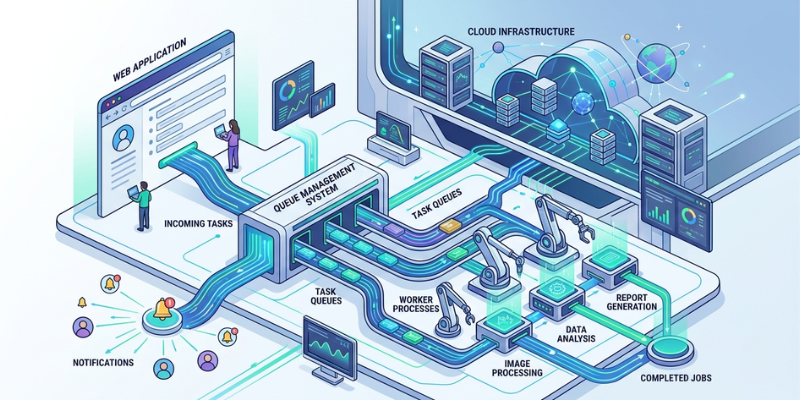
Modern web applications often handle thousands of tasks at the same time. Some actions need an instant response, while others can happen quietly in the background. This is where queues and background jobs become important. They help applications stay fast, organized, and reliable even when handling heavy workloads. If you want practical experience in building scalable applications, explore the Full Stack Developer Course in Mumbai at FITA Academy to strengthen your backend development skills further.
What are Queues in Web Applications
A queue is a system that stores tasks in an ordered manner until they are processed. It works like a waiting line at a ticket counter. Tasks enter the queue and wait for their turn to be completed.
In web development, queues are used when an application receives more tasks than it can process immediately. Instead of slowing down the entire application, the tasks are placed in a queue and handled one by one or in batches.
For example, when a user uploads a video to a social media platform, the application may need time to compress the file, generate thumbnails, and send notifications. These tasks do not need to happen instantly. The system can place them in a queue and process them later without affecting the user experience.
Understanding Background Jobs
Background jobs are tasks that run separately from the main application flow. They usually work behind the scenes and do not interrupt the user.
When a user performs an action on a website, the application should respond quickly. If the application tries to complete every heavy task immediately, users may experience delays or timeouts. Background jobs solve this problem by moving time-consuming tasks away from the main request.
Some common examples of background jobs include sending emails, processing payments, generating reports, resizing images, and syncing data with external services.
How Queues and Background Jobs Work Together
Queues and background jobs often work as a team. When a task is created, it is added to a queue. A worker process then picks up the task from the queue and completes it in the background.
This approach improves application performance because users do not have to wait for every task to finish before receiving a response. It also helps developers manage large numbers of requests more efficiently.
For example, imagine an online shopping application during a festival sale. Thousands of users may place orders at the same time. Instead of processing every email confirmation instantly, the system can add email tasks to a queue and process them gradually in the background. If you are interested in learning how modern systems handle such large-scale operations, you can take the Full Stack Developer Course in Kolkata to understand backend architecture and scalable application design in greater depth.
Benefits of Using Queues and Background Jobs
One major benefit is improved performance. Applications become faster because heavy tasks are processed separately from the main user request.
Another advantage is better scalability. As traffic grows, more workers can be added to process queued tasks efficiently. This helps applications manage increasing workloads without crashing.
Queues also improve reliability. If a task fails, it can often be retried automatically. This ensures important operations are not lost because of temporary issues.
Background jobs also help developers organize their systems more clearly. Tasks become easier to monitor, manage, and maintain over time.
Common Use Cases in Real Applications
Many modern platforms depend heavily on queues and background jobs. Streaming services use them to process videos. E-commerce websites use them to manage order confirmations and payment updates. Banking applications rely on them for transaction processing and fraud checks.
Even simple websites can benefit from this approach. A blog platform may use background jobs to send subscriber notifications whenever a new article is published.
As applications grow larger, the importance of queues and background processing also increases. They form a core part of scalable backend development.
Queues and background jobs play a major role in building fast and reliable applications. They help systems handle heavy tasks without slowing down the user experience. By separating important processes into manageable tasks, developers can create applications that perform efficiently even under high traffic.
Understanding these ideas is crucial for anyone wanting to pursue backend or full-stack development. Learning how task management works in modern applications can help developers build stronger and more scalable systems for real-world use. If you want to gain deeper knowledge in advanced backend workflows and scalable architecture, you can join the Full Stack Developer Course in Delhi to improve your full-stack development expertise with practical guidance.
Also check: Caching Fundamentals for Web Applications