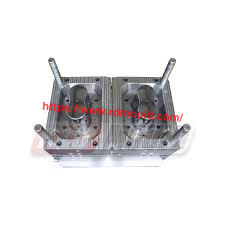
What Happens to Clamp Force When a Food Container Mould Uses a Stack Configuration? Rdmould Calculates

A factory runs a 500ton injection press. A standard mould produces one set of containers per cycle. The owner needs more output. Buying a second press costs space and capital. A Food Container Mould with stack design from Rdmould, produced by RuiDing, solves this problem. This mould type creates two parting lines instead of one. The machine stays the same. Output doubles. This situation raises a direct question for any production manager: why do some food container moulds use stack mould design for double the output on the same press size?
A stack mould contains two mould parting surfaces. The first opens to the stationary platen. The second opens to the moving platen. Rdmould's stack design places moulds backtoback around a center manifold. The injection barrel fills both cavities simultaneously. One machine cycle produces two complete sets of parts. A standard mould with the same machine produces only one set. The stack mould does not require a larger press or more floor space. It simply repurposes the existing clamp force.
Clamp force distribution differs in a stack mould. A standard mould requires the press to hold one parting line closed. Rdmould's stack design splits the required clamp force across two parting lines. Each parting line needs half the total tonnage. A part that requires 200 tons in a standard mould needs only 100 tons per parting line in a stack mould. The same 500ton press now has capacity for larger projected areas or higher cavitation. The machine's clamp capacity gets used efficiently.
Cooling time per part decreases in a stack mould. A standard mould's parts cool while the mould remains closed. The cooling time sets the cycle length. Rdmould's stack mould cools both sets of parts simultaneously. The cycle time does not increase because both parting lines open and close together. Parts from both moulds reach ejection temperature at the same moment. The output per hour doubles without adding cooling seconds. A stack mould effectively cuts the cooling cost per part by half.
Machine investment per cavity drops significantly. A production line needing 48 cavities would require two 500ton presses with standard moulds. Rdmould's stack mould puts 48 cavities into one 500ton press. The single press costs less than two presses. The mould costs more than a standard mould. The combined mould and machine expense still falls below the twopress line. A factory with limited capital expands output without buying a second machine. The stack mould offers lower entry cost for high volume.
Energy consumption per part improves. A standard mould uses the same hydraulic power for each cycle. Rdmould's stack mould produces twice the parts using nearly the same energy. The injection unit fills twice the cavity volume per stroke. The hydraulic pump, barrel heaters, and cooling system draw similar power. The energy per thousand parts drops by half. A plant running three shifts sees significant monthly savings. The stack mould pays its higher initial price through lower operating costs.
Material flow balancing challenges exist. A stack mould must fill both levels evenly. Rdmould designs center manifold systems with shearcontrolled distribution. The melt splits at the nozzle. Equal path lengths and diameters ensure balanced filling. A mould that fills one level before the other produces inconsistent parts. Rdmould's engineering analysis simulates melt flow before steel cutting. The finished mould fills both parting lines in the same time. A poorly designed stack mould fails at this critical point.
Parting line access for maintenance differs. A standard mould opens to one gap. Rdmould's stack mould opens to two gaps. The center section holds the manifold and moves with the press's moving platen. A technician can access both parting lines after the mould opens fully. The cooling lines and ejector systems require careful hose routing. Rdmould's stack mould includes long hoses that reach the center section. A standard mould uses shorter hoses. The maintenance time stays similar because both parting lines share the same design.
Production efficiency depends on cycle consistency. Rdmould's stack mould requires precise temperature control across both levels. A mold temperature controller supplies each level separately. The center section needs insulated water lines to prevent heat loss. A standard mould has simpler plumbing. The stack mould's extra complexity pays off in output. A plant that runs the same container for millions of cycles benefits from the stack design. A job shop that changes moulds daily may prefer standard singlelevel moulds.
For any manufacturer seeking higher output from existing machines, https://www.rdmould.com/news/industry-news/the-different-types-of-plastic-food-container-mould.html shows Rdmould's Food Container Mould stack configurations, where RuiDing engineers balance melt flow, cooling, and clamp force for double production on the same press. A stack mould uses your current machine's full capacity. A standard mould leaves potential output untapped. Does your mould design waste half your press's cycles or use every shot to its maximum?