President Trump Threatens Tax on U.S. Companies Building Overseas AI Data Centers
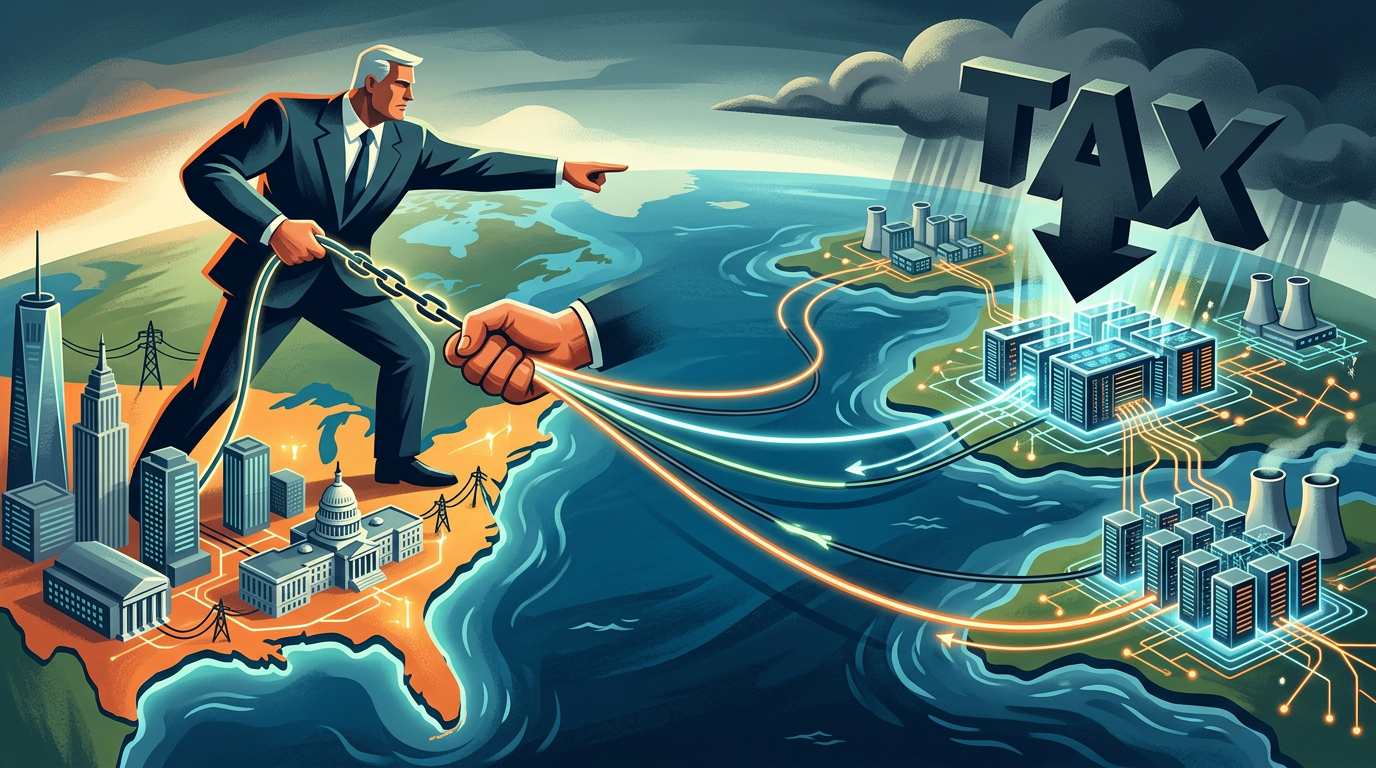
President Trump issued a significant threat on November 20, 2026, indicating plans to impose a substantial tax on U.S. companies that construct data centers abroad. This declaration, made without specifying a rate or legal mechanism, introduces new uncertainty into the landscape of global artificial intelligence infrastructure development. The warning directly impacts major AI projects, particularly those in the Gulf region involving American partners and chips, such as the Amazon Web Services and HUMAIN AI Zone in Saudi Arabia, and OpenAI's Stargate UAE initiative.This potential policy shift represents a new dimension in the ongoing efforts by Washington to regulate and control access to advanced AI computing capabilities. While the U.S. already employs export licenses to dictate where advanced AI computing resources are located globally, a direct tax would broaden the scope of intervention, potentially impacting the financial viability and strategic decisions of American tech giants. The ambiguity surrounding the tax's coverage adds a layer of risk for companies financing and developing international data center campuses.
The proposed tax could ignite further debate over presidential versus congressional authority in trade and taxation. While Congress typically writes tax law, the White House could leverage tariff or sanctions powers to implement such a measure. This development signals an escalation in the geopolitical maneuvering surrounding AI, compelling companies to re-evaluate their global expansion strategies and consider the increased regulatory and financial hurdles involved in establishing AI infrastructure outside the United States.
President Trump Threatens Tax on U.S. Companies Building Overseas AI Data Centers
President Trump issued a significant threat on November 20, 2026, indicating plans to impose a substantial tax on U.S. companies that construct data centers abroad. This declaration, made without specifying a rate or legal mechanism, introduces new uncertainty into the landscape of global artificial intelligence infrastructure development. The warning directly impacts major AI projects, particularly those in the Gulf region involving American partners and chips, such as the Amazon Web Services and HUMAIN AI Zone in Saudi Arabia, and OpenAI's Stargate UAE initiative.
This potential policy shift represents a new dimension in the ongoing efforts by Washington to regulate and control access to advanced AI computing capabilities. While the U.S. already employs export licenses to dictate where advanced AI computing resources are located globally, a direct tax would broaden the scope of intervention, potentially impacting the financial viability and strategic decisions of American tech giants. The ambiguity surrounding the tax's coverage adds a layer of risk for companies financing and developing international data center campuses.
The proposed tax could ignite further debate over presidential versus congressional authority in trade and taxation. While Congress typically writes tax law, the White House could leverage tariff or sanctions powers to implement such a measure. This development signals an escalation in the geopolitical maneuvering surrounding AI, compelling companies to re-evaluate their global expansion strategies and consider the increased regulatory and financial hurdles involved in establishing AI infrastructure outside the United States.
Sources
forbes.com https://vertexaisearch.cloud.google.com/grounding-api-redirect/AUZIYQEnTTofmdFs4cEvxdSCZNCZfF1VB4S30Oy7JAmSm1ft2pqT6Yl1-f0KyQCjm1nHPnnVH8i0F2637jsx2jxsxh-JKz-mw2cHBgQXbkwox5CV3Es5wOAJXRFx6B4mzrJOaWSL0Q2hjWEtyLXe-IYm5bsUToDwQWXMvlyIyg38oyQ0ieTOQf12GZmO0vUbMBRgkzV9vGzG7p7HBi9bx0Ai69NC66Q0OmCLyGfagHzMatJ1bO-cBowIvr9mCQ9Fuq0qX2wSVyiTTsuv1mHDtgEfGA==
#USPolicy #AIInfrastructure #GlobalTech #DataCenters #Geopolitics