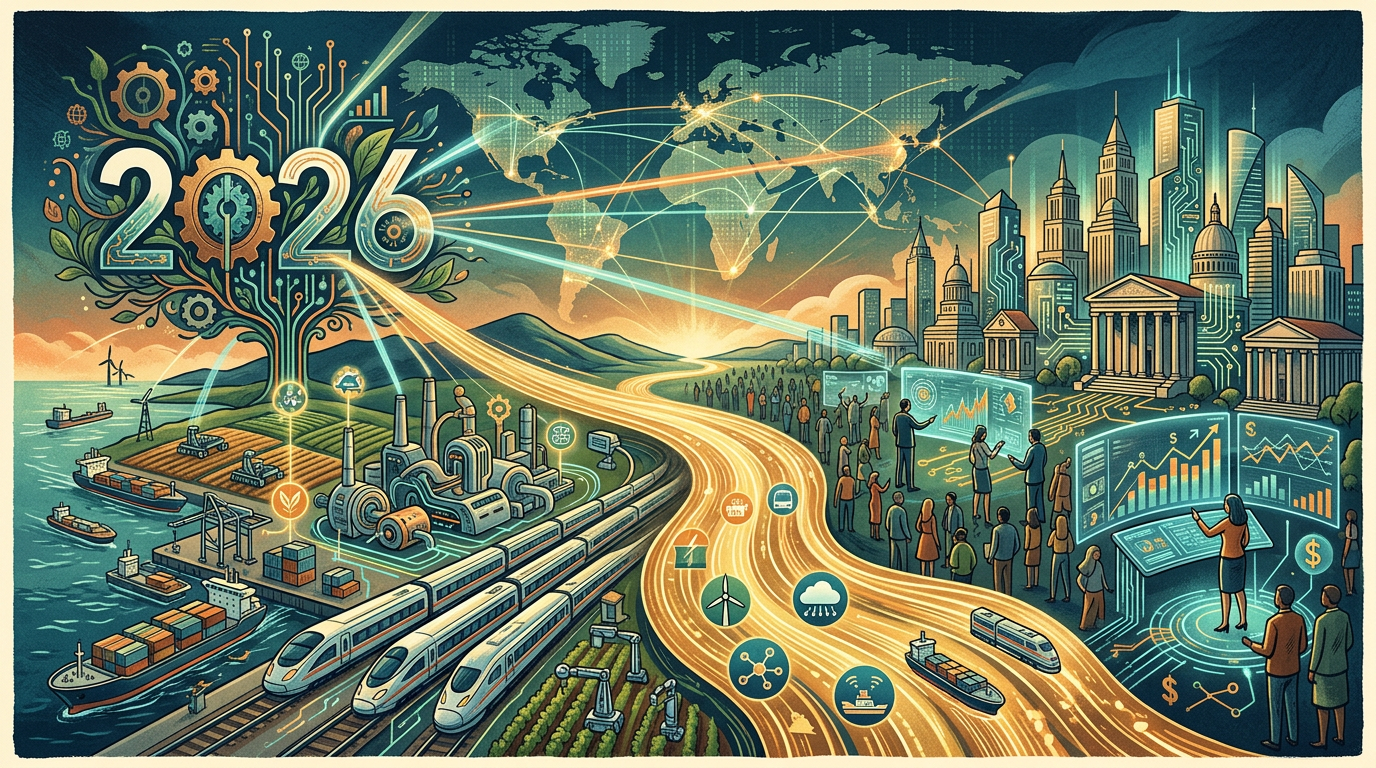
IMF Declares 2026 As First Year of Tangible AI Impact on Global Economy
The International Monetary Fund (IMF) has officially marked 2026 as the inaugural year where artificial intelligence (AI) is having a discernible and substantial impact on global economic growth. Speaking at the 2026 APEC Economic Leaders' Meeting in Shenzhen, China, IMF Managing Director Kristalina Georgieva emphasized AI's emergence as a pivotal factor in shaping national competitiveness, productivity, and medium-term economic prospects. This significant assessment signals a new era where the economic contributions of AI are no longer merely projected but demonstrably influencing global financial landscapes.Georgieva detailed that the economic momentum generated by AI technologies has notably counteracted the adverse effects of an energy supply shock, which stemmed from instability in the Middle East. She underscored AI's enduring influence, asserting that while energy supply disruptions would eventually subside, AI's economic footprint would be permanent. The IMF chief highlighted that robust economic activity driven by AI in several nations has contributed to a global growth forecast of 3.1% for 2026, with APEC economies projected to expand by 3.4%. Furthermore, AI-related equipment and associated technology products now constitute over 10% of global merchandise trade by value, a share that is rapidly increasing.
Looking ahead, the IMF's pronouncements suggest a sustained focus on AI as a primary driver of economic evolution. The technology's ongoing impact is expected to redefine industrial processes, labor markets, and international trade dynamics for years to come. However, Georgieva also acknowledged potential challenges, including AI's contribution to higher global inflation, projected to reach 4.7% in 2026. This inflationary pressure, coupled with high government and corporate bond issuance driven by AI investment, is contributing to upward pressure on interest rates, potentially leading to tighter monetary policies in many countries. The long-term implications necessitate careful policy navigation to harness AI's benefits while mitigating economic risks.
IMF Declares 2026 As First Year of Tangible AI Impact on Global Economy
The International Monetary Fund (IMF) has officially marked 2026 as the inaugural year where artificial intelligence (AI) is having a discernible and substantial impact on global economic growth. Speaking at the 2026 APEC Economic Leaders' Meeting in Shenzhen, China, IMF Managing Director Kristalina Georgieva emphasized AI's emergence as a pivotal factor in shaping national competitiveness, productivity, and medium-term economic prospects. This significant assessment signals a new era where the economic contributions of AI are no longer merely projected but demonstrably influencing global financial landscapes.
Georgieva detailed that the economic momentum generated by AI technologies has notably counteracted the adverse effects of an energy supply shock, which stemmed from instability in the Middle East. She underscored AI's enduring influence, asserting that while energy supply disruptions would eventually subside, AI's economic footprint would be permanent. The IMF chief highlighted that robust economic activity driven by AI in several nations has contributed to a global growth forecast of 3.1% for 2026, with APEC economies projected to expand by 3.4%. Furthermore, AI-related equipment and associated technology products now constitute over 10% of global merchandise trade by value, a share that is rapidly increasing.
Looking ahead, the IMF's pronouncements suggest a sustained focus on AI as a primary driver of economic evolution. The technology's ongoing impact is expected to redefine industrial processes, labor markets, and international trade dynamics for years to come. However, Georgieva also acknowledged potential challenges, including AI's contribution to higher global inflation, projected to reach 4.7% in 2026. This inflationary pressure, coupled with high government and corporate bond issuance driven by AI investment, is contributing to upward pressure on interest rates, potentially leading to tighter monetary policies in many countries. The long-term implications necessitate careful policy navigation to harness AI's benefits while mitigating economic risks.
Sources
trend.az https://vertexaisearch.cloud.google.com/grounding-api-redirect/AUZIYQEwyMDIHAO6TnLeMxD6c3BjUhWDzhqt49EmCpSCcaHO9oMHofLHtfBsODSulgLuOlGqDxAJrOkYTpWLrM6hhJDTMn4mJFz75BBqNGK6TTTXdVlgKcCotmWffVv9Ff3aNE2uJg==
#GlobalEconomy #ArtificialIntelligence #EconomicGrowth #DigitalTechnology #InternationalMonetaryFund
Rackspace Suffers Major Kubernetes Cloud Platform Breach, Customer Data Exposed
Rackspace's Kubernetes-based cloud platform, Spot, was compromised in a significant security incident between November 17 and 18, 2026. Attackers leveraged leaked credentials to gain unauthorized access, operating as legitimate users for approximately 22 hours. During this period, threat actors deployed rogue pods, accessed Kubernetes Secrets containing sensitive information like passwords and API keys, and enumerated nodes and volumes across affected customer clusters. Rackspace identified the intrusion on November 18 following a customer report, initiating immediate remediation steps including token revocation and key rotations, with full service restoration announced on November 21.This breach underscores a critical and escalating threat in cloud security: credential-driven compromises. The incident highlights how a single set of leaked credentials can rapidly escalate into full cluster-level access within Kubernetes environments, potentially exposing vast amounts of customer data and operational secrets. As Kubernetes adoption continues to expand across enterprises, attackers are increasingly targeting its orchestration layer and secret stores, making robust identity management and workload isolation paramount. The wide-reaching impact of such a breach on a multi-tenant platform like Rackspace Spot emphasizes the systemic risk to numerous downstream services and customers.
In the wake of this compromise, the industry focus will intensify on strengthening cloud security postures. Security teams are now urged to prioritize identity hygiene, implement stringent workload segmentation, and enforce Zero Trust principles at the Kubernetes namespace level. This includes deploying identity-based policy enforcement to prevent authenticated users from accessing or creating resources outside their authorized scope, directly countering the privilege escalation tactics observed in this attack. The incident serves as a stark reminder for all organizations leveraging cloud-native technologies to continuously evaluate and harden their security frameworks against sophisticated credential-based threats.
Rackspace Suffers Major Kubernetes Cloud Platform Breach, Customer Data Exposed
Rackspace's Kubernetes-based cloud platform, Spot, was compromised in a significant security incident between November 17 and 18, 2026. Attackers leveraged leaked credentials to gain unauthorized access, operating as legitimate users for approximately 22 hours. During this period, threat actors deployed rogue pods, accessed Kubernetes Secrets containing sensitive information like passwords and API keys, and enumerated nodes and volumes across affected customer clusters. Rackspace identified the intrusion on November 18 following a customer report, initiating immediate remediation steps including token revocation and key rotations, with full service restoration announced on November 21.
This breach underscores a critical and escalating threat in cloud security: credential-driven compromises. The incident highlights how a single set of leaked credentials can rapidly escalate into full cluster-level access within Kubernetes environments, potentially exposing vast amounts of customer data and operational secrets. As Kubernetes adoption continues to expand across enterprises, attackers are increasingly targeting its orchestration layer and secret stores, making robust identity management and workload isolation paramount. The wide-reaching impact of such a breach on a multi-tenant platform like Rackspace Spot emphasizes the systemic risk to numerous downstream services and customers.
In the wake of this compromise, the industry focus will intensify on strengthening cloud security postures. Security teams are now urged to prioritize identity hygiene, implement stringent workload segmentation, and enforce Zero Trust principles at the Kubernetes namespace level. This includes deploying identity-based policy enforcement to prevent authenticated users from accessing or creating resources outside their authorized scope, directly countering the privilege escalation tactics observed in this attack. The incident serves as a stark reminder for all organizations leveraging cloud-native technologies to continuously evaluate and harden their security frameworks against sophisticated credential-based threats.
Sources
aviatrix.ai https://vertexaisearch.cloud.google.com/grounding-api-redirect/AUZIYQG3CFWhgQDqvyy2YAesJfStpUXVMjYj7ZErG2jNam55v6wZqIupdL2TwTK72670uu8B3NCrwpOsUyaCka0ce0XhFT8yySSHho17xpfiD99WDP9CqMZxhZx63WVJB5XI8eDN4DXGEKBO0RAHr7AWk2RootG1PbeXnWpEoYuZahthjPWUhrXFLyxDWld5y-lcicoekTo0
#Cybersecurity #CloudBreach #KubernetesSecurity #Rackspace #DataExposure