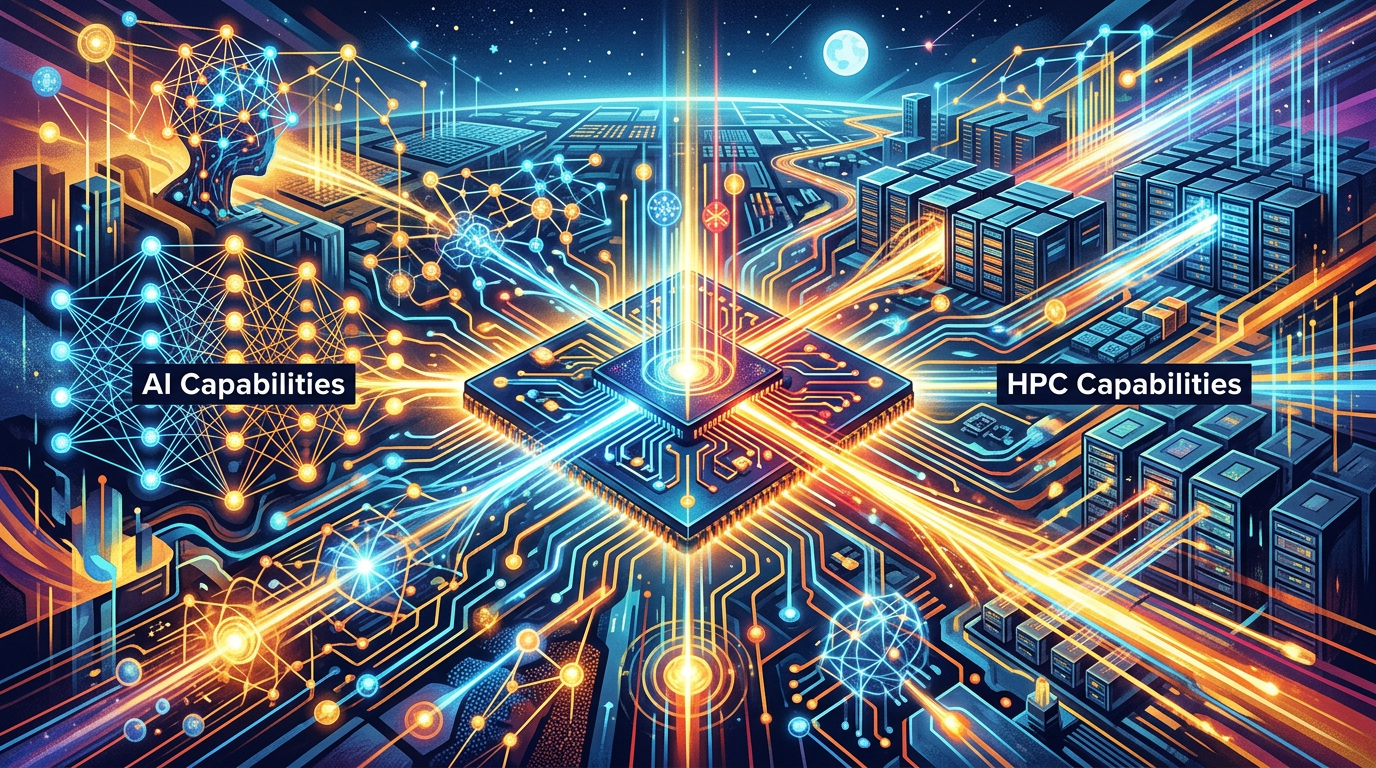
Q.ANT Unveils NPU Gen 2+ Photonic Processor, Advancing AI and HPC Capabilities
Q.ANT, a leader in commercial photonic computing, has unveiled its NPU Gen 2+ processor at SC26 in Chicago, marking a significant step forward for AI and high-performance computing (HPC). This latest generation Native Processing Unit introduces optical Discrete Fourier Transforms (DFTs), enabling developers to execute complex mathematical functions directly using light. The announcement signals a new era for AI model efficiency and speed, offering a novel approach to computationally intensive tasks.The integration of optical DFTs into the NPU Gen 2+ is crucial because it allows AI models to operate with fewer parameters and reduced data volumes, leading to faster and more energy-efficient operations. Traditionally, computing such transforms on conventional digital hardware consumes significant time and energy. Q.ANT demonstrated the practical application of this technology by showcasing a language model running on a hybrid photonic-GPU system, wherein optical calculations effectively replaced a demanding attention layer in the AI architecture. This innovation unlocks algorithmic and performance advantages by performing complex computations in a single pass of light.
Looking ahead, Q.ANT plans to enhance its software toolkit to fully support the expanded capabilities of the NPU Gen 2+. The company anticipates offering commercial systems that combine both Gen 2 and Gen 2+ processors in the latter half of 2027. This development underscores the growing potential of photonic computing to create more expressive and powerful AI models, further bridging the gap between theoretical advancements and practical, real-world AI applications.
Q.ANT Unveils NPU Gen 2+ Photonic Processor, Advancing AI and HPC Capabilities
Q.ANT, a leader in commercial photonic computing, has unveiled its NPU Gen 2+ processor at SC26 in Chicago, marking a significant step forward for AI and high-performance computing (HPC). This latest generation Native Processing Unit introduces optical Discrete Fourier Transforms (DFTs), enabling developers to execute complex mathematical functions directly using light. The announcement signals a new era for AI model efficiency and speed, offering a novel approach to computationally intensive tasks.
The integration of optical DFTs into the NPU Gen 2+ is crucial because it allows AI models to operate with fewer parameters and reduced data volumes, leading to faster and more energy-efficient operations. Traditionally, computing such transforms on conventional digital hardware consumes significant time and energy. Q.ANT demonstrated the practical application of this technology by showcasing a language model running on a hybrid photonic-GPU system, wherein optical calculations effectively replaced a demanding attention layer in the AI architecture. This innovation unlocks algorithmic and performance advantages by performing complex computations in a single pass of light.
Looking ahead, Q.ANT plans to enhance its software toolkit to fully support the expanded capabilities of the NPU Gen 2+. The company anticipates offering commercial systems that combine both Gen 2 and Gen 2+ processors in the latter half of 2027. This development underscores the growing potential of photonic computing to create more expressive and powerful AI models, further bridging the gap between theoretical advancements and practical, real-world AI applications.
Sources
thequantuminsider.com https://vertexaisearch.cloud.google.com/grounding-api-redirect/AUZIYQGA1qz5QblhPh2i8EpfBPL_tdSQc-mT14IwfrkEqYfRUX0Nw48SxSke4cs2gho1JLowCmI-eaMSQc6mvx3LGNSfLy8ZB-fNye5VwrxnADhw1yS502iDGD8apBYkL41iZhUxTy02YiPpQG57a8I-zCNmg6mNwFQKRG5XP_UNtSQ921g4wq6AsvzuMV8slAI8KKE8WMLKRkQ-h1fkjmIve1PWhHIsDUAu
#PhotonicComputing #AIHardware #HighPerformanceComputing #QANT #NPUGen2Plus
Nvidia Halts H200 AI Chip Shipments to China Amid Export Control Scrutiny
Nvidia, a leading global technology giant, has announced the suspension of shipments of its advanced H200 AI chips to China. This significant move was disclosed by Nvidia's acting Chief Financial Officer, Colette Kress, in a recent interview, confirming that the high-performance AI accelerators are no longer being delivered to the Chinese market. The H200 chips, crucial for training and running complex artificial intelligence models, fall under specific export licensing requirements, which have become increasingly stringent in the ongoing geopolitical landscape.This decision marks a critical development in the technology trade tensions between the United States and China. The halt directly impacts China's ability to access cutting-edge AI hardware, potentially slowing the advancement of its domestic AI capabilities and research. It underscores the effectiveness of tightened U.S. export controls aimed at restricting China's access to advanced semiconductor technology for national security reasons. The move also highlights the delicate balance Nvidia must maintain between its global market interests and compliance with governmental regulations.
The suspension is expected to send ripples across the global semiconductor supply chain and further intensify the push for indigenous chip development within China. While approximately 10% of Nvidia's total product shipments to China previously included gaming, automotive, and workstation products, the absence of the H200 AI chips will force Chinese tech companies to explore alternative solutions or accelerate their own advanced chip production. This event is a clear indication of the escalating role of technology, particularly AI and chips, in international geopolitical strategies and economic competition.
Nvidia Halts H200 AI Chip Shipments to China Amid Export Control Scrutiny
Nvidia, a leading global technology giant, has announced the suspension of shipments of its advanced H200 AI chips to China. This significant move was disclosed by Nvidia's acting Chief Financial Officer, Colette Kress, in a recent interview, confirming that the high-performance AI accelerators are no longer being delivered to the Chinese market. The H200 chips, crucial for training and running complex artificial intelligence models, fall under specific export licensing requirements, which have become increasingly stringent in the ongoing geopolitical landscape.
This decision marks a critical development in the technology trade tensions between the United States and China. The halt directly impacts China's ability to access cutting-edge AI hardware, potentially slowing the advancement of its domestic AI capabilities and research. It underscores the effectiveness of tightened U.S. export controls aimed at restricting China's access to advanced semiconductor technology for national security reasons. The move also highlights the delicate balance Nvidia must maintain between its global market interests and compliance with governmental regulations.
The suspension is expected to send ripples across the global semiconductor supply chain and further intensify the push for indigenous chip development within China. While approximately 10% of Nvidia's total product shipments to China previously included gaming, automotive, and workstation products, the absence of the H200 AI chips will force Chinese tech companies to explore alternative solutions or accelerate their own advanced chip production. This event is a clear indication of the escalating role of technology, particularly AI and chips, in international geopolitical strategies and economic competition.
Sources
azernews.az https://vertexaisearch.cloud.google.com/grounding-api-redirect/AUZIYQEAFyuy3ooy4bnTT-b5_HZITed0Bv0xeNtFdUReHI5EmfmgWQ9WrKr37g5B_z8ZoRlG0xwHkKq5xjI1k-DAMr80EcZNfON78S-maaXpdmw9AyqlU_zBLJfgz-qkVBm_XktVN0Fi
#Nvidia #AIChips #ExportControls #China #Geopolitics