Malaysia’s Frozen Convenience Foods Market Expands Despite Price Sensitivity
Consumers Prioritize Convenience Over Traditional Food Habits
Malaysia’s consumers are steadily shifting away from time-intensive home cooking, accelerating demand for frozen convenience foods even as fresh and wet-market options remain widely available. Rising urbanization, longer working hours, and the growing share of dual-income households are reshaping food consumption patterns across Malaysia. As a result, frozen ready meals, snacks, and processed proteins are gaining traction in both household and foodservice channels.
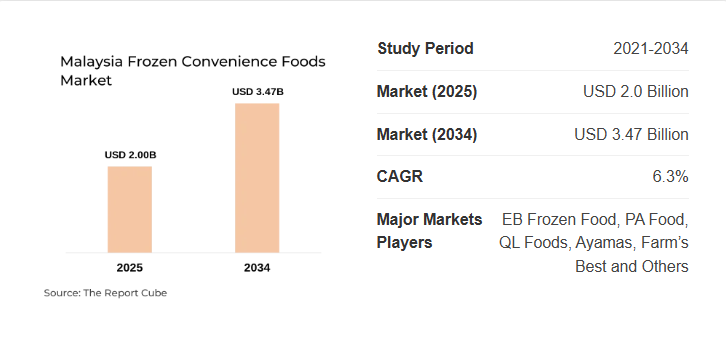
Market data indicates that the Malaysia frozen convenience foods market was valued at approximately USD 2.0 billion in 2025 and is projected to expand at a CAGR of over 6% through 2034, reflecting sustained demand for quick-preparation meal solutions.
Retail Sales Grow Even as Consumers Remain Price Conscious
Despite ongoing sensitivity to food inflation, retail sales of frozen foods continue to rise. Supermarkets and hypermarkets remain the dominant sales channel, supported by frequent promotions and improved freezer space allocation. At the same time, online grocery platforms are recording faster growth, aided by better cold-chain delivery capabilities in urban regions.
Notably, consumers are not trading down on quantity as much as they are reallocating spend toward perceived value favoring multi-serve frozen meals, frozen snacks, and bulk protein packs that offer longer shelf life and reduced food waste.
Download this research report Complimentary sample copy - https://www.thereportcubes.com/request-sample/frozen-convenience-foods-market-malaysia
(This preview includes the report framework and overview only. Detailed market data and forecasts are available in the full paid report.)
Localized Products Drive Adoption
Product localization is a central growth lever. Halal-certified frozen foods with familiar Malaysian flavors such as curry-based meals, breaded chicken, and frozen flatbreads are outperforming imported Western-style offerings. This reflects a broader consumer preference for convenience without sacrificing cultural taste profiles.
Frozen ready-to-cook items, rather than fully prepared meals, are also seeing higher uptake, as they allow households to balance speed with customization. This hybrid consumption behavior continues to support volume growth across multiple product categories.
Cold-Chain Expansion Supports Market Penetration
Investment in cold storage, refrigerated transport, and retail freezer infrastructure has significantly reduced distribution constraints. Peninsular Malaysia accounts for the largest share of consumption due to dense retail coverage, while East Malaysia is showing steady growth as logistics capabilities improve.
However, cold-chain costs remain structurally high, limiting penetration in lower-income and rural areas. This creates a two-speed market, where urban demand accelerates faster than nationwide averages.
Policy and Industry Goals Are Not Fully Aligned
While food manufacturers and retailers continue to expand frozen portfolios, broader food policy objectives such as affordability and nutrition remain difficult to balance. Rising electricity and logistics costs affect freezer operations across the supply chain, putting pressure on margins and retail pricing.
Industry players are responding through portion optimization, private-label expansion, and selective premiumization rather than broad price increases.
Market Momentum Remains Strong, but Risks Are Emerging
The market’s growth trajectory remains intact, supported by demographic shifts and lifestyle changes. However, overreliance on urban demand and modern retail exposes the sector to consumption slowdowns if household budgets tighten further.
Some categories, particularly premium frozen meals, may face demand elasticity if price gaps widen relative to fresh alternatives. As a result, 2026-2027 is expected to be a period of portfolio rationalization, with manufacturers prioritizing high-rotation SKUs and cost-efficient formats.
According to The Report Cube, frozen convenience foods in Malaysia will continue to benefit from structural lifestyle changes, though long-term growth will increasingly depend on cost control, distribution efficiency, and localized product strategies rather than demand expansion alone.
Outlook
Malaysia’s frozen convenience foods market is no longer niche-driven it is behavior-driven. While affordability and infrastructure challenges persist, consumer reliance on convenience is becoming entrenched. This positions the market for steady, consumption-led expansion through the next decade, even as competition intensifies and margins remain under pressure.
Recently Published Market Studies:
Indonesia Frozen Processed Foods Market Report and Forecast 2026-2034
Japan Digestive Health Food Products Market Report and Forecast 2026-2034
South Korea Collagen Drinks Market Report and Forecast 2026-2034
Categories
Read More
(圖/ 翻攝自牛角臉書) 臺灣知名餐飲集團捷利國際餐飲股份有限公司,因母公司五互集團於2023年爆出非法吸金高達220億元,導致資金鏈斷裂、營運無以為繼,最終於同年7月無預警宣布倒閉。旗下約30間門市全數歇業,約500名員工在未接獲任何預警情況下瞬間失業,重挫餐飲業信心,也引發社會關注。 WEAREGO 捷利國際餐飲曾為臺灣代理日本三大知名品牌之一,旗下包括「牛角燒肉專門店」、「Pepper Lunch胡椒廚房」及「MAiSEN邁泉豬排」,同時自創多個品牌如捷果咖啡、空居酒屋、元町家横浜家系拉麵、樁涮HOT POT與丸米便當,曾在臺灣市場攻城掠地,展店遍及北中南。 (圖/ 本報記者翻攝)...
(圖/ 國土管理署) 內政部國土管理署今(11)日召開「弱勢脆弱家庭關懷及訪視」說明會議,邀集衛生福利部社會及家庭署、各縣市政府及國家住宅及都市更新中心共同參與,宣布啟動跨部會弱勢租屋關懷服務專案,結合住宅政策與社會安全網機制,協助承租不具合法建物資格之弱勢家庭,逐步轉租至安全、合法的居住環境。 國土署指出,隨著租金補貼新制於今年(115年)正式上路,過去承租具繳交房屋稅之未保存登記建物(如頂樓加蓋)的舊戶,目前仍可享有一年緩衝補助期。為避免弱勢族群在補貼調整過程中面臨居住風險,政府同步推動關懷服務專案,透過跨部會合作與社會包租代管等機制,協助租戶順利銜接合法租屋資源。 MGBOX (圖/ 國土管理署)...

Transportation is a vital part of daily life. Whether you are commuting to work, visiting family, or traveling to the airport, having a reliable mode of transportation can make your day smoother. In Addlestone, taxi services have become a key solution for residents and visitors alike. Taxi Addlestone offers a convenient, safe, and efficient way to navigate the town and beyond, improving...