BIS FMCS Scheme: Complete Guide to FMCS License & Certificate
Introduction
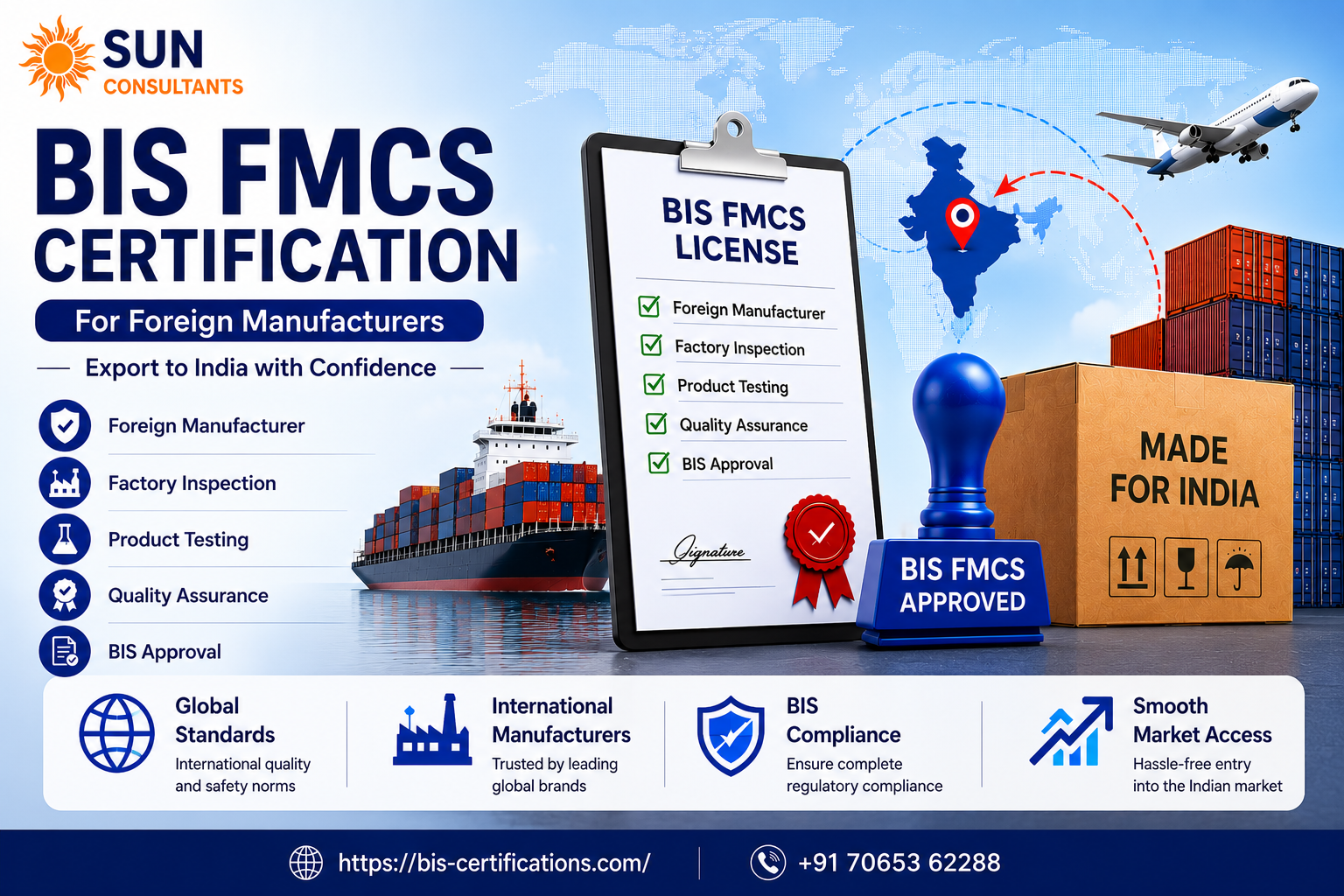
Expanding into the Indian market offers significant opportunities for foreign manufacturers, but compliance with Indian quality standards is essential. One of the key regulatory requirements for many foreign manufacturers is obtaining a BIS FMCS approval. The BIS FMCS Scheme enables overseas manufacturers to certify their products according to Indian Standards, allowing them to sell regulated products legally in India. Whether you manufacture electrical products, chemicals, steel, construction materials, or other regulated goods, obtaining a BIS FMCS License and BIS FMCS Certificate demonstrates that your products meet India's safety and quality requirements. This guide explains everything you need to know about the FMCS scheme, including eligibility, application process, documentation, benefits, and compliance requirements.
What is BIS FMCS?
BIS FMCS stands for the Foreign Manufacturers Certification Scheme, a certification program administered by the Bureau of Indian Standards (BIS). The scheme allows foreign manufacturers to obtain certification for products that must comply with Indian Standards before being imported and sold in India. Under the FMCS scheme, manufacturers can obtain permission to use the Standard Mark after successfully completing product testing, factory inspection, and document verification. The objective of BIS FMCS is to ensure that imported products maintain the same quality and safety standards as products manufactured within India.
What is the BIS FMCS Scheme?
The BIS FMCS Scheme is specifically designed for manufacturers located outside India. It provides a structured certification process that verifies whether products comply with the applicable Indian Standard (IS).
The scheme generally involves:
-
Application submission
-
Technical document verification
-
Product testing in BIS-recognized laboratories
-
Factory inspection by BIS officials
-
Evaluation of manufacturing and quality systems
-
Grant of certification
After successful approval, the manufacturer receives authorization to use the BIS Standard Mark on certified products.
What is a BIS FMCS License?
A BIS FMCS License is the official approval issued to eligible foreign manufacturers after they successfully complete the certification process under the Foreign Manufacturers Certification Scheme. The license authorizes manufacturers to produce and export certified products to India while complying with applicable Indian Standards. Holding a valid FMCS license also demonstrates a manufacturer's commitment to product quality, regulatory compliance, and consumer safety.
What is a BIS FMCS Certificate?
The BIS FMCS Certificate is evidence that a foreign manufacturing facility and its products have met BIS requirements under the FMCS scheme.
The certificate confirms that:
-
The product complies with the relevant Indian Standard.
-
Manufacturing processes meet BIS requirements.
-
Product testing has been successfully completed.
-
Factory inspections have been conducted where applicable.
-
The manufacturer is authorized to use the BIS Standard Mark.
Who Needs BIS FMCS Certification?
The BIS FMCS Scheme is applicable to foreign manufacturers whose products fall under mandatory BIS certification requirements.
Eligible applicants include:
-
Manufacturers located outside India
-
Companies exporting products to India
-
Global brands entering the Indian market
-
Manufacturers covered under Quality Control Orders (QCOs)
Importers should ensure that their overseas suppliers possess the required BIS approval before importing regulated products.
Benefits of BIS FMCS
Obtaining BIS FMCS certification offers several important advantages.
Access to the Indian Market
Certification enables foreign manufacturers to legally supply regulated products in India.
Regulatory Compliance
Manufacturers meet Indian legal and quality requirements.
Consumer Confidence
Products carrying the BIS Standard Mark are generally trusted for their quality and safety.
Competitive Advantage
Certified products often gain stronger acceptance among distributors, retailers, and customers.
Improved Brand Reputation
Compliance with Indian Standards demonstrates a commitment to international quality practices.
Reduced Import Risks
Proper certification helps avoid customs delays, product rejection, and regulatory penalties.
Documents Required for BIS FMCS License
Although requirements differ depending on the product category, the following documents are commonly required:
-
Business registration documents
-
Manufacturing license
-
Factory layout
-
Product specifications
-
Manufacturing process details
-
Quality management documents
-
Calibration records
-
Product test reports
-
Trademark documents (if applicable)
-
Authorized Indian Representative (AIR) details
-
Quality control procedures
Accurate documentation plays an important role in achieving timely certification.
Step-by-Step BIS FMCS Certification Process
The certification process generally follows these stages:
Step 1: Product Standard Identification
Identify the applicable Indian Standard for the product.
Step 2: Documentation Preparation
Compile technical documents and manufacturing records.
Step 3: Application Submission
Submit the application with supporting documents to BIS.
Step 4: Product Testing
Products are tested in BIS-recognized laboratories to verify compliance.
Step 5: Factory Inspection
BIS officials inspect the overseas manufacturing facility to assess production and quality systems.
Step 6: Technical Evaluation
BIS reviews inspection findings, laboratory reports, and application documents.
Step 7: Grant of BIS FMCS License
Once compliance is confirmed, BIS issues the BIS FMCS License and BIS FMCS Certificate, allowing the manufacturer to use the Standard Mark.
Common Challenges During BIS FMCS Certification
Foreign manufacturers may experience delays because of:
-
Incomplete documentation
-
Incorrect application details
-
Non-compliant product testing
-
Factory inspection observations
-
Delays in laboratory reports
-
Communication gaps with regulatory authorities
Proper planning and technical preparation can significantly improve the certification timeline.
Maintaining BIS FMCS Compliance
After obtaining certification, manufacturers must continue to:
-
Maintain consistent product quality
-
Follow applicable Indian Standards
-
Cooperate during surveillance inspections
-
Maintain quality management systems
-
Conduct regular product testing
-
Keep technical records updated
Ongoing compliance helps ensure continued validity of the certification.
Why BIS FMCS is Important for Foreign Manufacturers
India has one of the world's largest consumer markets, making regulatory compliance essential for successful business expansion. The BIS FMCS Scheme ensures that imported products meet the same quality and safety standards as domestically manufactured products. By obtaining a BIS FMCS License and BIS FMCS Certificate, foreign manufacturers can strengthen customer confidence, improve market access, and reduce regulatory risks while building long-term business opportunities in India.
Conclusion
The BIS FMCS certification process is a vital requirement for many foreign manufacturers planning to export products to India. Through the BIS FMCS Scheme, manufacturers demonstrate compliance with Indian Standards, ensuring product quality, safety, and legal market access. Obtaining a BIS FMCS License and BIS FMCS Certificate not only fulfills regulatory obligations but also enhances brand credibility and supports sustainable business growth in the Indian market. Careful preparation, complete documentation, and adherence to BIS requirements can help streamline the certification process and avoid unnecessary delays.