Outliers and What They Reveal About Data
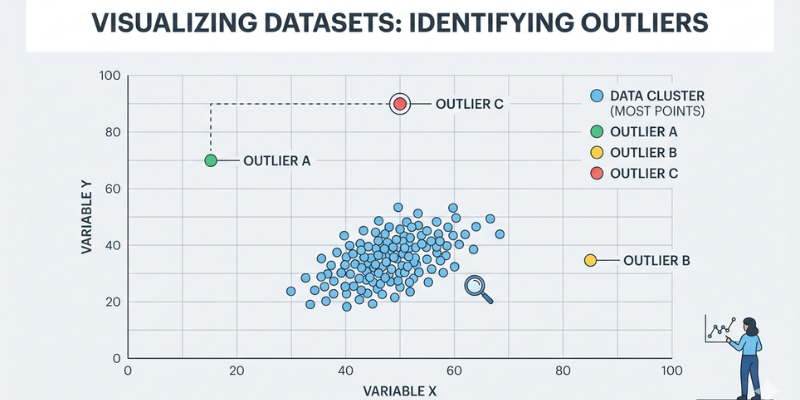
Outliers are data points that look very different from most other values in a dataset. These values can be extremely high or extremely low compared to the general pattern of the data. In data science, outliers are important because they often change how we interpret results and build models. Sometimes they represent errors in data entry, and other times they reflect real and meaningful behavior. Understanding them helps beginners build stronger analytical thinking and avoid misleading conclusions.
Outliers often appear in real-life situations, like income data, where a few individuals earn much more than the majority. They also appear in sensor readings, customer transactions, and even exam scores. Instead of ignoring them, data scientists study them carefully to understand whether they should be removed or kept. Learning how to handle such unusual values builds a strong foundation in data analysis. If you want to explore structured learning with practical guidance, consider enrolling in a Data Science Course in Mumbai at FITA Academy to strengthen your fundamentals in handling real-world datasets and building analytical confidence for future projects.
Why Outliers Matter in Data Analysis
Outliers are not just random strange numbers, they often carry hidden information about the system being studied. In some cases, they may indicate data entry mistakes or technical issues during collection. In other situations, they may reveal rare but important events that deserve attention. This is why understanding outliers is a key skill in data science.
Outliers can significantly affect averages and statistical results. For example, a few extremely large values can increase the mean and make it less representative of the dataset. This can lead to incorrect business decisions if not handled properly. That is why analysts often compare median and mean to understand data better.
Outliers can also be classified into different types. Some are point outliers, where a single value is unusual compared to others. Some are contextual outliers, which depend on conditions like time or location. There are also collective outliers, where a group of values behaves differently from the rest of the dataset. Each type requires a different approach for analysis.
Detecting outliers usually involves visual methods like box plots or statistical methods that measure distance from average behavior. These techniques help analysts decide whether to remove, adjust, or investigate unusual data points more deeply.
For learners who want structured practice and deeper understanding of these analytical techniques, joining a Data Science Course in Kolkata can help you build strong hands-on skills in identifying patterns and improving data quality through guided learning modules.
How Outliers Influence Real World Decisions
Outliers play a major role in decision-making because they can either highlight problems or reveal opportunities. In finance, an outlier transaction might signal fraud or unusual customer behavior. In healthcare, an outlier reading might indicate a rare medical condition that needs attention. In manufacturing, it might show a defect in production that must be corrected.
Handling outliers correctly is important because ignoring them can lead to incomplete analysis. At the same time, blindly removing them can also remove valuable insights. Data scientists often investigate the source of outliers before deciding what to do with them. This careful approach ensures better accuracy in predictions and reporting.
Outliers also help in improving machine learning models. When models are trained without properly handling unusual data, their performance can become unstable. By understanding outliers, data scientists can build models that are more reliable and robust in real-world situations.
In conclusion, outliers are not just errors or noise in data. They are signals that can improve understanding when studied carefully. Learning how to work with them is an essential step in becoming a skilled data professional. If you are ready to build advanced analytical thinking and work on real datasets, consider joining a Data Science Course in Delhi to take your learning journey further and gain practical industry-oriented experience.
Also check: How to Summarize and Visualize Your Dataset with Basic Statistics

