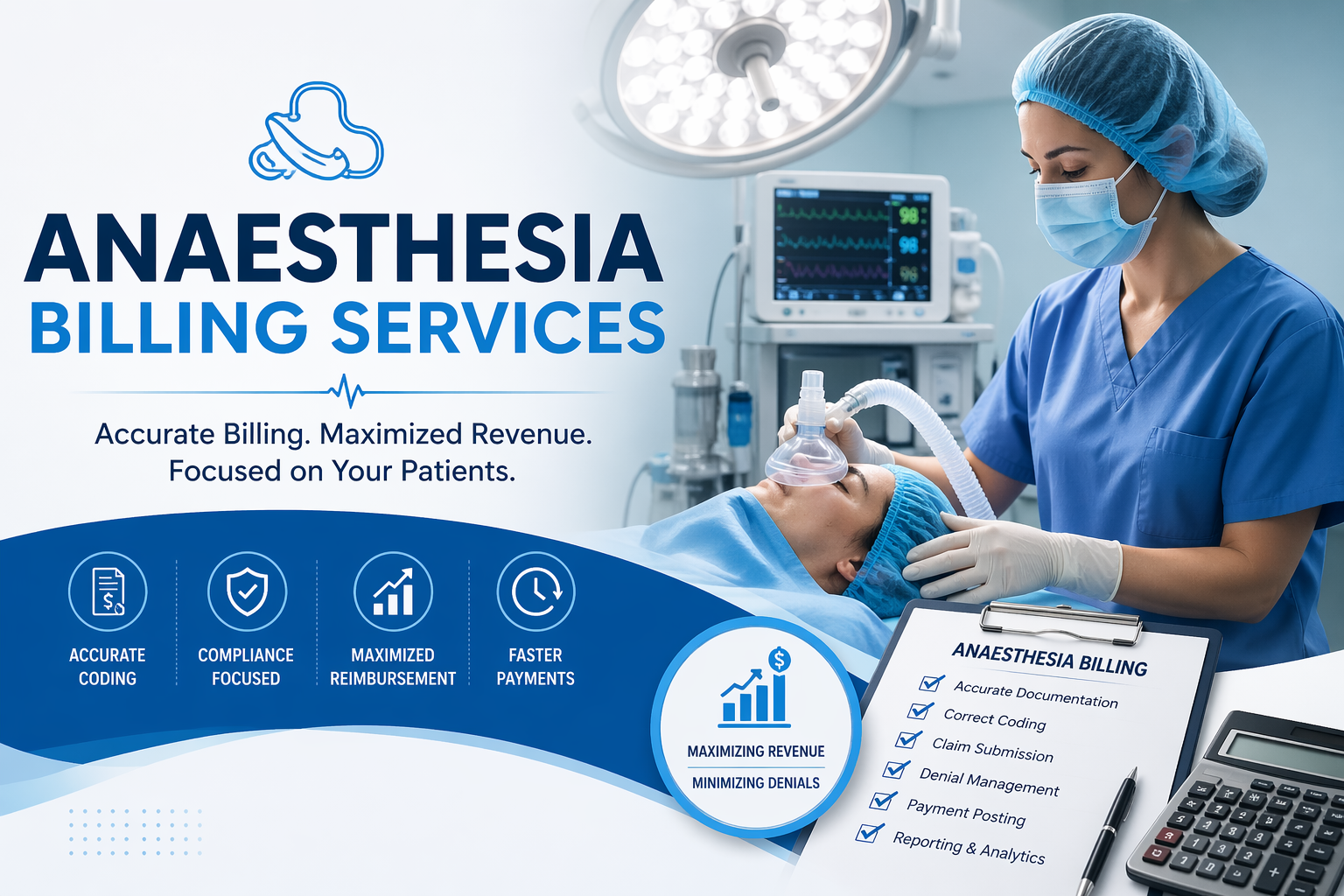
Anesthesia Billing and Coding Services: A Complete Guide for Healthcare Practices

Introduction
Anesthesia billing and coding services are among the most complex areas in the entire medical revenue cycle management (RCM) ecosystem. Unlike standard fee-for-service specialties, anesthesia reimbursement depends on a multi-variable system that includes base units, time units, modifier usage, and strict payer-specific rules. Even a small documentation error can lead to underpayment or claim denial.
The stakes are high. Industry reports indicate that anesthesia practices may lose 15–25% of potential revenue due to billing inefficiencies and claim errors when workflows are not optimized. Additionally, studies show anesthesia claim denial rates can reach around 19%, largely due to coding and documentation mistakes.
This makes specialized anesthesia billing and coding services essential for hospitals, ASCs, and independent anesthesia groups aiming to maintain compliance and protect revenue. This blog explains key challenges, how to reduce denials, and how expert partners like 247 Medical Billing Services improve outcomes.
Billing Challenges in Anesthesia Billing and Coding Services
Anesthesia billing is not like standard CPT-based billing. It follows a unique formula:
Base Units + Time Units + Modifier Units × Conversion Factor = Reimbursement
This structure introduces multiple points of failure.
1. Time-Based Complexity
Anesthesia billing depends heavily on precise time tracking. Even a few minutes’ discrepancy between documentation and claim submission can reduce reimbursement or trigger denials. Time is typically measured in 15-minute increments, making accuracy critical.
2. Modifier Errors
Modifiers such as AA, QK, QX, and QZ determine provider roles (anesthesiologist vs CRNA vs medical direction). Incorrect modifier usage is one of the most common reasons for rejected claims.
3. Documentation Gaps
Missing start/stop times, ASA physical status, or medical direction notes often leads to claim rejection or delays.
4. Code Mapping Complexity
Each surgical procedure must be mapped to the correct anesthesia CPT/ASA code, which is not always a one-to-one relationship.
5. High Denial Risk
Anesthesia billing sits among the highest denial-prone specialties due to strict payer rules and evolving compliance requirements.
How to Choose the Right Anesthesia Billing Partner
Selecting the right partner for anesthesia billing and coding services directly impacts revenue cycle performance. Look for:
- Specialized anesthesia coding expertise (ASA + CPT mapping)
- Strong denial management system with appeal tracking
- Automated time-unit capture tools
- High first-pass claim acceptance rate (95% or above ideal)
- Dedicated CRNA and anesthesiologist billing experience
- Real-time reporting dashboards for transparency
- Compliance-driven workflows aligned with HIPAA and payer rules
A strong partner does more than submit claims—they actively prevent revenue leakage before it happens.
How to Reduce Anesthesia Billing Denials
Reducing denials in anesthesia billing and coding services requires structured process control, not just correction after rejection.
1. Standardize Time Capture
Ensure every anesthesia case records exact start and stop times. Avoid rounding or estimations, as even small errors can trigger payment issues.
2. Audit Modifier Usage Regularly
Conduct monthly audits for modifier accuracy (AA, QX, QZ, etc.). Incorrect modifiers are a leading cause of denial spikes.
3. Strengthen Pre-Bill Scrubbing
Use automated or manual claim scrubbing before submission to catch missing documentation or mismatched codes.
4. Improve Documentation Training
Train clinical staff to consistently capture:
- ASA physical status
- medical direction details
- procedure duration
- intraoperative notes
5. Monitor Denial Patterns
Track recurring denial codes and fix upstream causes instead of repeatedly resubmitting claims.
HIPAA Compliance and Technology in Anesthesia Billing
Modern anesthesia billing and coding services rely heavily on secure, technology-driven systems. HIPAA compliance is non-negotiable, especially when handling sensitive anesthesia and surgical records.
Key technology components include:
- Encrypted EHR integration systems
- HIPAA-compliant cloud billing platforms
- Automated coding and claim validation tools
- AI-based denial prediction systems
- Secure audit trails for all claim modifications
These technologies not only protect patient data but also improve billing accuracy and reduce manual errors.
How 247 Medical Billing Services Helps Anesthesia Practices
247 Medical Billing Services specializes in complex medical billing workflows, including anesthesia billing and coding services designed for high-volume surgical environments.
Their approach focuses on:
- End-to-end anesthesia revenue cycle management
- Accurate base, time, and modifier unit calculations
- Dedicated anesthesia coding specialists
- Pre-claim auditing to reduce denials before submission
- Fast denial resolution and appeals management
- Compliance-first billing aligned with HIPAA standards
By combining automation with expert coding review, 247 Medical Billing Services helps anesthesia groups reduce revenue leakage, improve cash flow stability, and maintain payer compliance across multiple facilities.
Conclusion and CTA
Anesthesia billing and coding services require precision, specialization, and constant compliance monitoring. With time-sensitive billing models, complex modifier rules, and strict payer guidelines, even experienced healthcare teams struggle to maintain consistent reimbursement performance.
Without a structured system, practices risk losing up to a quarter of their revenue through avoidable errors and denials. The solution is a dedicated, anesthesia-focused billing partner that understands the nuances of this specialty.
247 Medical Billing Services provides end-to-end anesthesia billing support designed to improve accuracy, reduce denials, and maximize reimbursements. If your practice is facing claim delays, coding errors, or revenue leakage, partnering with a specialized team can transform your financial performance.