Smart Contract Audits Explained in Simple Terms
Smart contracts power much of today’s blockchain economy. They automate financial transactions, govern decentralized applications, manage token launches, and execute complex logic without intermediaries. This automation is precisely what makes smart contracts powerful but it is also what makes them dangerous when something goes wrong. A single error in code can lock funds forever, expose users to theft, or collapse an entire protocol within minutes. This is why smart contract audits have become one of the most critical safeguards in the crypto ecosystem.
This article explains smart contract audits in simple, practical terms, without sacrificing depth or accuracy. It breaks down what audits are, why they matter, how they work, what they can and cannot guarantee, and how projects should approach them strategically. Rather than presenting a superficial checklist, this guide focuses on real-world context, historical lessons, and the deeper value audits provide for security, trust, and long-term sustainability.
What Is a Smart Contract Audit, Really?
At its core, a smart contract audit is a structured security review of blockchain code conducted by specialized experts. The goal is to identify vulnerabilities, logic errors, and design flaws before the contract is deployed or widely used. Unlike traditional software testing, audits assume a hostile environment one where attackers actively look for weaknesses and are financially motivated to exploit them.
An audit examines not only whether the code works as intended, but whether it can be manipulated in unintended ways. This includes analyzing how contracts behave under extreme conditions, unexpected inputs, or complex interactions with other contracts.
In simple terms, a smart contract audit asks three fundamental questions:
-
Does the contract do what it claims to do?
-
Can it be abused or broken?
-
What happens if something goes wrong?
Why Smart Contract Audits Are So Important
Smart contracts are immutable once deployed, meaning errors cannot be easily fixed. In traditional software, a bug can be patched after discovery. On a blockchain, a bug can be exploited instantly and permanently. According to multiple blockchain security reports, billions of dollars have been lost due to smart contract vulnerabilities over the past few years, with many exploits occurring within days or even hours of deployment.
For users, audits reduce the risk of losing funds. For projects, audits protect reputation, credibility, and long-term viability. A single exploit can destroy trust overnight, regardless of how innovative or well-funded a project may be.
Audits also serve as a signaling mechanism. In an ecosystem where anyone can deploy code, an audited contract demonstrates professionalism and accountability. While an audit is not a guarantee of safety, it significantly raises the bar for attackers.
What Auditors Actually Look For
Many people assume auditors simply search for “bugs,” but the scope is much broader. Auditors evaluate contracts across multiple dimensions, combining technical scrutiny with an understanding of economic incentives and attack vectors.
Common areas of focus include:
-
Logical correctness, ensuring the contract’s behavior matches its intended purpose
-
Access control, verifying that only authorized roles can execute sensitive functions
-
State management, checking that contract states transition safely and predictably
-
External interactions, analyzing how calls to other contracts or oracles could be exploited
-
Economic vulnerabilities, such as manipulation through flash loans or pricing assumptions
Auditors also assess code readability and structure. Poorly organized code is harder to reason about and more likely to contain hidden flaws.
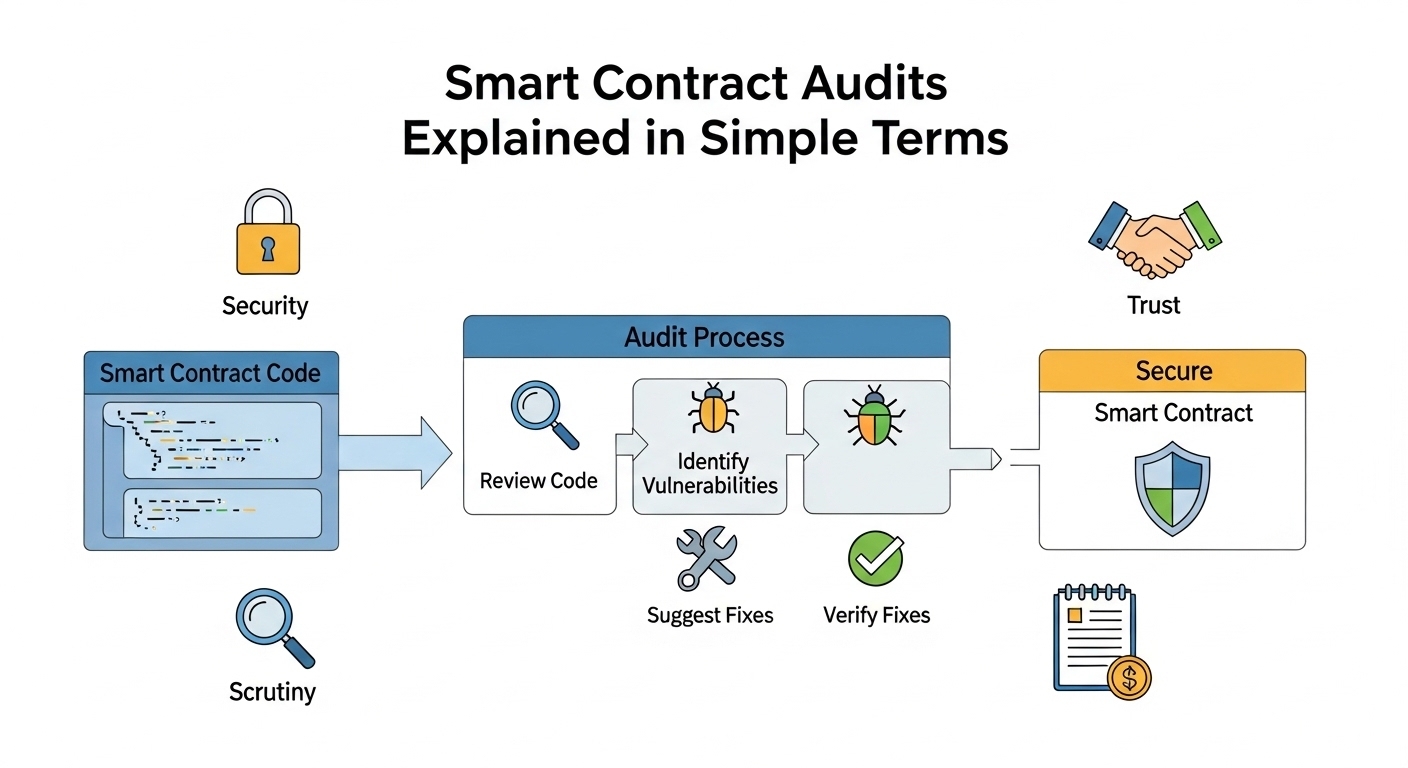
The Smart Contract Audit Process, Step by Step
While methodologies vary between firms, most audits follow a similar process designed to balance thoroughness with efficiency.
Next comes automated analysis, using tools that scan for known vulnerability patterns. These tools are effective for catching common issues but are always supplemented by human judgment. After vulnerabilities are identified, auditors compile a report detailing each issue, its severity, and recommended fixes.
Finally, many audits include a remediation and re-review phase, where developers fix issues and auditors verify that the fixes were implemented correctly.
Understanding Audit Severity Levels
Audit reports often categorize issues by severity, which helps teams prioritize fixes. While terminology may differ, severity generally reflects potential impact and exploitability.
-
Critical issues can lead to direct loss of funds or total contract failure
-
High-risk issues enable serious exploitation under certain conditions
-
Medium-risk issues may not be immediately exploitable but weaken security
-
Low-risk issues involve best practices, code clarity, or minor inefficiencies
Understanding these distinctions is important. Not all findings are equally dangerous, but ignoring “non-critical” issues can still create future risks, especially as contracts interact with a growing ecosystem.
Real-World Examples: Why Audits Matter
Some of the most famous smart contract failures highlight the consequences of insufficient auditing. Early decentralized finance protocols suffered reentrancy attacks, logic errors, and flawed economic assumptions that allowed attackers to drain funds legally according to the contract’s own rules.
In contrast, many mature protocols credit rigorous auditing for their resilience. Projects that underwent multiple audits, implemented recommendations, and continued security reviews over time were better prepared to withstand attack attempts. These examples show that audits are not about perfection, but about reducing risk to acceptable levels.
What Audits Can and Cannot Guarantee
A common misconception is that an audited contract is “safe.” In reality, audits reduce risk they do not eliminate it. Auditors work within defined scopes and time constraints. They cannot predict every future interaction, market condition, or novel attack technique.
Audits also rely on assumptions about intended behavior. If the underlying design is flawed, even perfectly implemented code can fail economically. This is why audits are most effective when paired with strong design, testing, and ongoing monitoring.
Understanding these limitations helps projects avoid complacency and treat audits as part of a broader security strategy rather than a one-time checkbox.
Audits vs. Testing: How They Work Together
Smart contract testing and auditing are complementary, not interchangeable. Testing verifies that contracts behave correctly under expected conditions. Auditing assumes adversarial behavior and looks for edge cases developers may not have considered.
Projects that rely solely on audits without comprehensive testing often face avoidable issues. Conversely, teams that combine extensive testing with professional audits achieve far stronger security outcomes. The most resilient protocols treat audits as validation layers on top of already robust development practices.
When Should a Project Get a Smart Contract Audit?
Timing matters. Ideally, audits should occur after core functionality is implemented but before deployment. Auditing unfinished code wastes resources, while auditing after deployment exposes users to unnecessary risk.
For complex systems, multiple audits may be appropriate one for core contracts and another after significant upgrades or feature additions. In fast-moving ecosystems like DeFi, ongoing audits and reviews are increasingly common.
Choosing the Right Audit Partner
Not all auditors offer the same depth or expertise. Choosing the right partner requires evaluating experience, transparency, and methodology. Reputable Smart Contract Auditing Services provide clear scopes, detailed reports, and meaningful recommendations rather than generic findings.
Comprehensive Smart Contract Audit Solutions often combine manual review, automated analysis, and post-fix verification. Working with a trusted Smart Contract Auditing Company ensures that security assessments are thorough, credible, and aligned with industry best practices.
Projects should also value communication. The best auditors explain issues clearly, helping teams understand not just what is wrong, but why it matters.
Audits as a Trust-Building Tool
Beyond security, audits play a critical role in building trust. Investors, users, and partners increasingly expect audits as a baseline requirement. Publishing audit reports demonstrates transparency and accountability, signaling that a project takes user safety seriously.
In competitive markets, this trust can become a differentiator. Projects that proactively invest in audits often attract more engaged communities and higher-quality participants.
The Future of Smart Contract Auditing
As smart contracts grow more complex, auditing is evolving. New tools, formal verification methods, and continuous monitoring systems are enhancing traditional audits. At the same time, attackers are becoming more sophisticated, exploiting economic design rather than simple coding errors.
This arms race reinforces a key lesson: security is not static. Audits must evolve alongside the ecosystem, integrating new techniques and adapting to emerging risks.
Conclusion
Smart contract audits exist because blockchain systems are powerful, immutable, and unforgiving. They provide a structured way to identify weaknesses before attackers do, protecting users, projects, and the broader ecosystem.
In simple terms, an audit is about asking hard questions early when answers still matter. It does not guarantee safety, but it dramatically improves the odds of success. For any project handling real value, smart contract audits are not an optional expense; they are a foundational investment in security, credibility, and long-term survival.
Categories
Read More
If you’re looking to buy old Facebook accounts, you’ve come to the right place. Whether you're a digital marketer, a small business owner, or someone looking to leverage Facebook for advertising or marketplace access, old Facebook accounts offer significant advantages. At EverSMM, we provide verified, secure, and ready-to-use aged accounts tailored to your specific needs. This guide...

Introduction About Micky van de Ven Micky van de Ven is a commanding presence at the heart of defence, a Dutch centre-back whose physical stature and technical assurance make him a formidable opponent. Standing tall at 1.93 meters, he patrols the defensive line for Tottenham Hotspur in the English Premier League, where he wears the number 37 shirt with distinction. His journey to North London...

(圖/ 總統府) 2026年1月30日,「日台防災論壇」在高雄登場,賴清德總統以錄影方式致詞,強調臺灣與日本在災害防治領域長期互助合作,並期盼透過雙方交流,建立亞洲乃至全球防災韌性的示範典範。 總統表示,臺灣與日本不僅共享民主價值,也同處環太平洋地震帶與颱風頻繁區域,面對自然災害的挑戰,兩國始終互相支援,從過去震災救援到現今防災經驗共享,這份跨國友誼已成為雙方最珍貴的資產。 本屆論壇聚集日本仙台市、熊本市,以及臺灣高雄市、臺南市,共同交流都市災害防治與韌性城市建設經驗。賴清德總統指出,仙台市在311地震後的重建成果已成全球韌性城市典範;熊本市在半導體產業與臺灣緊密連結的同時,也在地下水資源保護及防災規劃上提供寶貴經驗。...