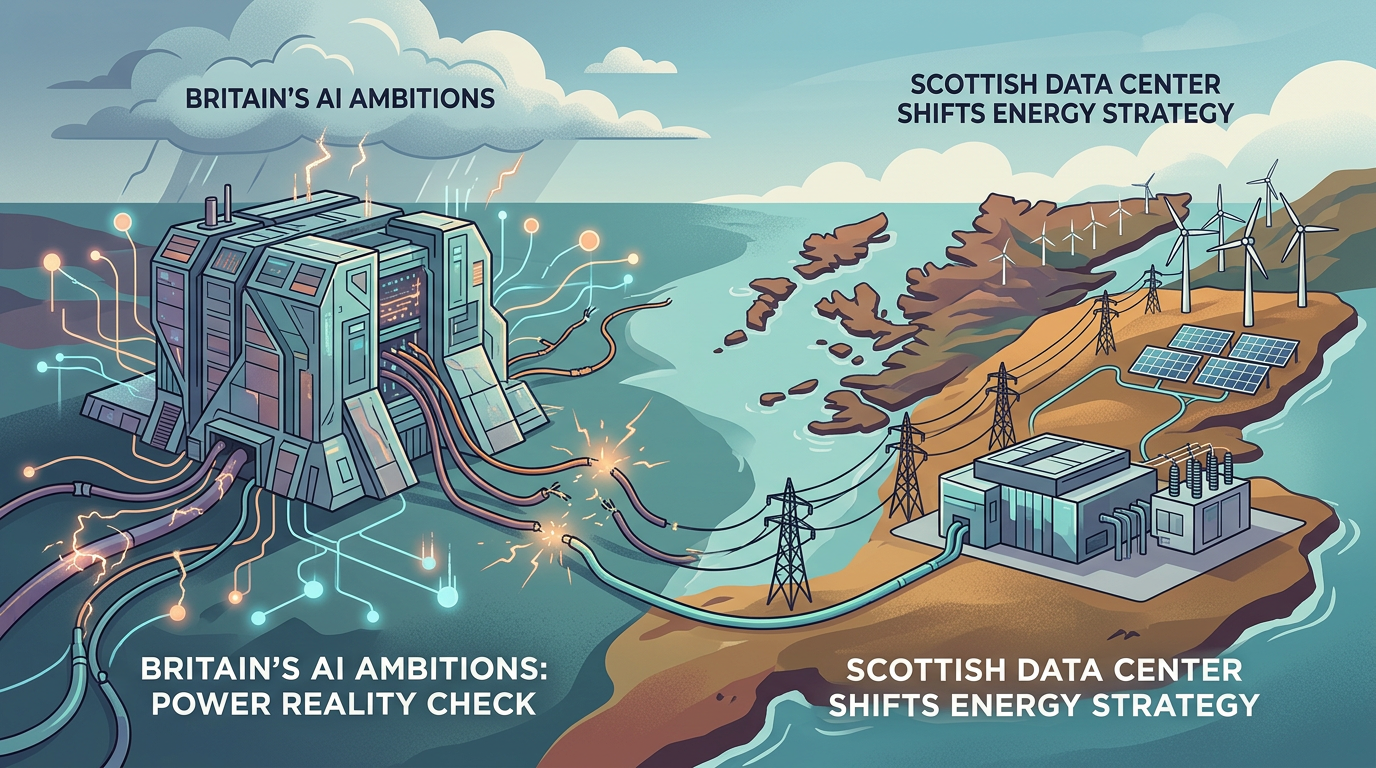
Britain's AI Ambitions Face Power Reality Check as Scottish Data Center Shifts Energy Strategy
A recent report by The Guardian on November 7, 2026, has brought to light a significant challenge facing Britain's aspirations to become a global leader in artificial intelligence: securing adequate and sustainable power for its burgeoning AI data centers. The report detailed a major AI data center development in Scotland, initially touted for its private connections to renewable energy generation, now planning to rely on National Grid supply, albeit supported by renewable electricity contracts. This pivot underscores a growing discrepancy between ambitious investment announcements and the practical realities of energy infrastructure.The data center in question, located at Chapelhall near Airdrie, is part of an AI Growth Zone and was previously associated with plans for over a gigawatt of wind, solar, and battery capacity via private wires. However, the Guardian's investigation, further elaborated on by a Medium article on November 8, indicates a shift towards a fully grid-supplied model. While the developer maintains its commitment to renewable energy through power-purchase agreements, the distinction between a physical private wire connection and grid reliance is crucial for both energy independence and the direct impact on local grids.
This development matters significantly as it exposes a broader "power problem" for the UK's AI strategy. The rapid expansion of AI computing capacity demands immense electricity, and the reliance on existing grid infrastructure, even with renewable energy certificates, highlights the infrastructural gap. The event prompts critical questions about the feasibility of scaling AI without commensurate, dedicated green energy production. It emphasizes the urgent need for realistic and integrated energy planning to support the enormous power requirements of future AI development, ensuring that Britain's digital ambitions are met with robust and sustainable energy solutions.
Britain's AI Ambitions Face Power Reality Check as Scottish Data Center Shifts Energy Strategy
A recent report by The Guardian on November 7, 2026, has brought to light a significant challenge facing Britain's aspirations to become a global leader in artificial intelligence: securing adequate and sustainable power for its burgeoning AI data centers. The report detailed a major AI data center development in Scotland, initially touted for its private connections to renewable energy generation, now planning to rely on National Grid supply, albeit supported by renewable electricity contracts. This pivot underscores a growing discrepancy between ambitious investment announcements and the practical realities of energy infrastructure.
The data center in question, located at Chapelhall near Airdrie, is part of an AI Growth Zone and was previously associated with plans for over a gigawatt of wind, solar, and battery capacity via private wires. However, the Guardian's investigation, further elaborated on by a Medium article on November 8, indicates a shift towards a fully grid-supplied model. While the developer maintains its commitment to renewable energy through power-purchase agreements, the distinction between a physical private wire connection and grid reliance is crucial for both energy independence and the direct impact on local grids.
This development matters significantly as it exposes a broader "power problem" for the UK's AI strategy. The rapid expansion of AI computing capacity demands immense electricity, and the reliance on existing grid infrastructure, even with renewable energy certificates, highlights the infrastructural gap. The event prompts critical questions about the feasibility of scaling AI without commensurate, dedicated green energy production. It emphasizes the urgent need for realistic and integrated energy planning to support the enormous power requirements of future AI development, ensuring that Britain's digital ambitions are met with robust and sustainable energy solutions.
Sources
medium.com https://vertexaisearch.cloud.google.com/grounding-api-redirect/AUZIYQHCJuKBeCsTDEvo2vmNy1GcMbyxQNBaQF528o4k9EIU9mpnm8hdIUDSteqxcnmMgD1eSw36J0Dap_q0eMNEFyB5MLFwyTz6q_W8jRHnX3DOXkg-AqHNIggk4S3IpyhCnrucyjiPUXuvj-GF24CVEsV9WyduyB6Rrx3RBG3MqBO2-OP5aNT2ZGU_U9_NqJjiil2CDFAwjF5MQqUyMbP-fKDoCDJ2
#AIInfrastructure #GreenEnergy #UKTech #DataCenters #EnergyPolicy
Lumai Unveils 3D Optical AI Inference Servers to Slash Data Center Energy Consumption
OXFORD, England – Lumai, an optical compute company, has announced a groundbreaking deployment of its 3D optical inference technology by the Advanced Research and Invention Agency (ARIA), a UK government-backed R&D funding organization. This world-first initiative aims to drastically reduce the energy consumption of AI data centers by up to 90% and increase processing speeds by 50 times for large language models (LLMs). The Lumai Iris™ inference servers will be integrated into ARIA's Scaling Inference Lab, operated by CommonAI CIC, to evaluate optical compute in a commercial data center environment.This innovation addresses the critical challenge of escalating energy demands from AI data centers, which currently pose significant environmental and economic concerns. Lumai's Iris technology performs AI computation using beams of light in three-dimensional space, leveraging passive optical components like lenses for mathematical operations. This method consumes a negligible amount of energy for computation, a stark contrast to conventional GPU architectures that rely on power-intensive transistors.
The deployment builds on the April 2026 launch of Iris Nova, Lumai's first optical AI accelerator designed for data center-scale inference. Researchers will assess the technology's potential to cut total cost of ownership to approximately one-tenth of traditional GPU systems. This development could catalyze a broader shift towards more sustainable and efficient AI infrastructure, paving the way for advanced AI capabilities without the prohibitive energy footprint.
The company expects to validate its roadmap through this real-world system operating in a commercial setting. The ability to deploy such a system at scale with existing semiconductor manufacturing equipment could significantly accelerate the adoption of electronic-photonic integration, as noted by research from MIT's FUTUR-IC program on similar technologies.
Lumai Unveils 3D Optical AI Inference Servers to Slash Data Center Energy Consumption
OXFORD, England – Lumai, an optical compute company, has announced a groundbreaking deployment of its 3D optical inference technology by the Advanced Research and Invention Agency (ARIA), a UK government-backed R&D funding organization. This world-first initiative aims to drastically reduce the energy consumption of AI data centers by up to 90% and increase processing speeds by 50 times for large language models (LLMs). The Lumai Iris™ inference servers will be integrated into ARIA's Scaling Inference Lab, operated by CommonAI CIC, to evaluate optical compute in a commercial data center environment.
This innovation addresses the critical challenge of escalating energy demands from AI data centers, which currently pose significant environmental and economic concerns. Lumai's Iris technology performs AI computation using beams of light in three-dimensional space, leveraging passive optical components like lenses for mathematical operations. This method consumes a negligible amount of energy for computation, a stark contrast to conventional GPU architectures that rely on power-intensive transistors.
The deployment builds on the April 2026 launch of Iris Nova, Lumai's first optical AI accelerator designed for data center-scale inference. Researchers will assess the technology's potential to cut total cost of ownership to approximately one-tenth of traditional GPU systems. This development could catalyze a broader shift towards more sustainable and efficient AI infrastructure, paving the way for advanced AI capabilities without the prohibitive energy footprint.
The company expects to validate its roadmap through this real-world system operating in a commercial setting. The ability to deploy such a system at scale with existing semiconductor manufacturing equipment could significantly accelerate the adoption of electronic-photonic integration, as noted by research from MIT's FUTUR-IC program on similar technologies.
Sources
prnewswire.co.uk https://vertexaisearch.cloud.google.com/grounding-api-redirect/AUZIYQHclAeZAqPwXvrBR7rUngvuahW19vO2tq3yTvylDGXe5cIV0x5foLuyDWwQfUMUc8QTqpyZoh2gN0IM1OTmNfrh9E19qR0pVVUAD9BjTnQjavWom8RP3YOes0xvL4n41VTyAeOIdyEuRP3ZjAXnK3OBvoBs-Bcz_rLuAWeBcA_Y071zOHb2s7kEe__Nau2OYbJGIE5GxkI4jmCVZBjLHOKjwATiah52XppFjQ-LzBAVdD4Ja5ZkitKrzSRx4KQxq2mX1yLUjm56V5HaTmw73j9A
prnewswire.com https://vertexaisearch.cloud.google.com/grounding-api-redirect/AUZIYQG4XolxtbWeszwtaLfsUVfI2SCxZSIQQHL4pf6RotReD-27wb2va8Q2PiniLoeuDRmGfCAYeci4H5_-qWni42fUcVYnAh3JOO7plAhWHGnw2PyNcne39uR1rf7AOyEQPYcSSHKyvfFGoY6Nqz2ZZ4Wv2MM0Yi9_oRZLLA5_JYQr7Qd-_EgTGaeCsNPkhAb9K8hxf5dMmNK5FWLF2ASrtReOHYdxne1-m9wZSmoBh_CVBrNIQIFyYbUricYdpXwKxAP8js95fjA5XzJLqx-nsw==
kucoin.com https://vertexaisearch.cloud.google.com/grounding-api-redirect/AUZIYQFygubJoSZAsQtmnpKh_pYwlN6y7B0dhr411FmwlB1aw1YDHz4YDvZq7UOIvToGwi7D9ReMdMxv1myNHDV9djLrQZ9p1e4ryR9-2w1SVgW_SEvPoR4T3KKvhMtwDS1JHDKBy9kyag2aq2KiTGrTCTWna0TmHlj2PgSFDiafD7YA0A3mSgT_WI_eN_3bIDTfuGs4QzUF1pp7HrRN9bnqI_9p8lIwhnwchUL18-fzhPKqEgWqeBV-xQ==
#OpticalComputing #AIDataCenters #EnergyEfficiency #AIInfrastructure #SustainableTech
European Union Boosts AI-Native 6G Research with €22 Million Funding
The European Smart Networks and Services Joint Undertaking (SNS JU) has announced a significant investment of €22 million to propel Europe's 6G research into industrial innovation. This funding will support five new proposals, specifically designed to accelerate promising 6G technologies from the research phase to large-scale testing and real-world application. The initiative aims to strengthen Europe's leadership in AI-native 6G, foster extensive experimentation, enhance connected devices, and solidify international partnerships in the telecommunications sector.This strategic investment is critical for Europe to secure its technological sovereignty and competitive edge in the rapidly advancing global race for next-generation connectivity. By focusing on AI-native 6G, the SNS JU addresses the growing need to integrate artificial intelligence directly into network architectures, promising more efficient, secure, and responsive communication systems. Such advancements are vital for supporting future applications like highly autonomous systems, extended reality, and advanced digital twins, which demand unprecedented levels of network performance and intelligent resource management.
Looking ahead, the €22 million in funding is set to significantly accelerate the development and rigorous testing of these advanced AI-native 6G capabilities across Europe. These projects are expected to play a crucial role in informing the global 3GPP 6G standardization process, with technical requirements anticipated to be outlined by 2025. The SNS JU's ambitious funding, matched by industry contributions, underscores Europe's commitment to fostering technology sovereignty and ensuring its foundational role in shaping the commercial deployment of 6G, which is projected to commence around 2030.
European Union Boosts AI-Native 6G Research with €22 Million Funding
The European Smart Networks and Services Joint Undertaking (SNS JU) has announced a significant investment of €22 million to propel Europe's 6G research into industrial innovation. This funding will support five new proposals, specifically designed to accelerate promising 6G technologies from the research phase to large-scale testing and real-world application. The initiative aims to strengthen Europe's leadership in AI-native 6G, foster extensive experimentation, enhance connected devices, and solidify international partnerships in the telecommunications sector.
This strategic investment is critical for Europe to secure its technological sovereignty and competitive edge in the rapidly advancing global race for next-generation connectivity. By focusing on AI-native 6G, the SNS JU addresses the growing need to integrate artificial intelligence directly into network architectures, promising more efficient, secure, and responsive communication systems. Such advancements are vital for supporting future applications like highly autonomous systems, extended reality, and advanced digital twins, which demand unprecedented levels of network performance and intelligent resource management.
Looking ahead, the €22 million in funding is set to significantly accelerate the development and rigorous testing of these advanced AI-native 6G capabilities across Europe. These projects are expected to play a crucial role in informing the global 3GPP 6G standardization process, with technical requirements anticipated to be outlined by 2025. The SNS JU's ambitious funding, matched by industry contributions, underscores Europe's commitment to fostering technology sovereignty and ensuring its foundational role in shaping the commercial deployment of 6G, which is projected to commence around 2030.
Sources
europa.eu https://vertexaisearch.cloud.google.com/grounding-api-redirect/AUZIYQFcHIN3DfmyMijUYqlvIBwW7PPKtxONUK4UNIqOcSNAN9cVI3uSlIcAL45-AQmrfUvDmAVzCtIc_TNc5KlGhP1tehlYsDIdxLhh5xT3l4xNZUSg9bRtpq-Viqt6fw==
6g-ia.eu https://vertexaisearch.cloud.google.com/grounding-api-redirect/AUZIYQH2ZiEx2JoUfq1vN4UJPSHQUfYoXIPO-NvsLKUYvvwVGTjkLiaE6bJT81GH2vU7WUexC_PSzg2MlolZeEqOfQONA9FOyZ-SEBrQK8oTuaGaDtxRhBsdEKvxsk0VbGB50e5vZITb9xTHiqXl3FhkCGaEh4EJIEXC4qKLL488dIDQbxvudQDUmMlxQmWhL0nvCBRgDXGGn21H
youtube.com https://vertexaisearch.cloud.google.com/grounding-api-redirect/AUZIYQFarzOb4kkn8IhdmKoFzzr2QvLqKFknx57AaMKU5PbNobZMYMYv7NnHzoEenMGugtEcquu9gh9lbenerRGO6NrNbUtScZpPtBrEZcVjV4j_BUGJWN5F8RhfMPsdSODbTCtHnzUdLu0=
#EuropeanUnion #AI #Telecommunications #SNSJU #ResearchFunding
Seoul Secures Henkel's Advanced Semiconductor Packaging R&D Center for AI Chips
Seoul has successfully attracted German chemical and consumer goods giant Henkel to establish a new research and development center focused on advanced semiconductor packaging materials within the Gasan Digital Complex. The Seoul Metropolitan Government announced the signing of a memorandum of understanding with Henkel on November 9, 2026. This strategic investment will see Henkel inject 12.1 billion won (approximately $9.2 million USD) into the facility by 2031 and create 15 specialized research positions, including master's and doctoral-level scientists.The new R&D center is poised to play a critical role in the advancement of AI semiconductors and next-generation High-Bandwidth Memory (HBM) technologies. Semiconductor packaging is essential for protecting sensitive chips, connecting them to other components, and managing the significant heat generated during operation, especially in stacked HBM chips. Henkel plans to develop crucial materials such as liquid molding underfill (L-MUF) for chip protection, advanced thermal materials for heat dissipation, and bonding materials to enhance structural stability. This initiative significantly bolsters South Korea's ecosystem for advanced chip manufacturing materials.
Looking ahead, Henkel intends to consolidate its existing R&D operations across South Korea into this new Seoul facility, creating a unified hub for innovation. The center will also facilitate expanded joint research efforts with local semiconductor companies, aiming to develop materials precisely tailored to their specifications. This collaboration is expected to accelerate breakthroughs in critical materials essential for the next generation of AI and high-performance computing hardware, further solidifying South Korea's leadership in the global semiconductor industry.
Seoul Secures Henkel's Advanced Semiconductor Packaging R&D Center for AI Chips
Seoul has successfully attracted German chemical and consumer goods giant Henkel to establish a new research and development center focused on advanced semiconductor packaging materials within the Gasan Digital Complex. The Seoul Metropolitan Government announced the signing of a memorandum of understanding with Henkel on November 9, 2026. This strategic investment will see Henkel inject 12.1 billion won (approximately $9.2 million USD) into the facility by 2031 and create 15 specialized research positions, including master's and doctoral-level scientists.
The new R&D center is poised to play a critical role in the advancement of AI semiconductors and next-generation High-Bandwidth Memory (HBM) technologies. Semiconductor packaging is essential for protecting sensitive chips, connecting them to other components, and managing the significant heat generated during operation, especially in stacked HBM chips. Henkel plans to develop crucial materials such as liquid molding underfill (L-MUF) for chip protection, advanced thermal materials for heat dissipation, and bonding materials to enhance structural stability. This initiative significantly bolsters South Korea's ecosystem for advanced chip manufacturing materials.
Looking ahead, Henkel intends to consolidate its existing R&D operations across South Korea into this new Seoul facility, creating a unified hub for innovation. The center will also facilitate expanded joint research efforts with local semiconductor companies, aiming to develop materials precisely tailored to their specifications. This collaboration is expected to accelerate breakthroughs in critical materials essential for the next generation of AI and high-performance computing hardware, further solidifying South Korea's leadership in the global semiconductor industry.
Sources
ajupress.com https://vertexaisearch.cloud.google.com/grounding-api-redirect/AUZIYQH-7eA-g1bgMsn-IBT7OI4nh9KK8Rov4bmJdITK4GpteOmjT2TuBLg369cOpZwTIhJxbXNz_FIWgLVpEyXrD8k_CTX2PR59YOZtV-cLuJ9y_l7lgvP0h9SyDkXFJaCWPYe0bMjTkpE=
#Semiconductor #AIHardware #AdvancedPackaging #SouthKorea #Henkel