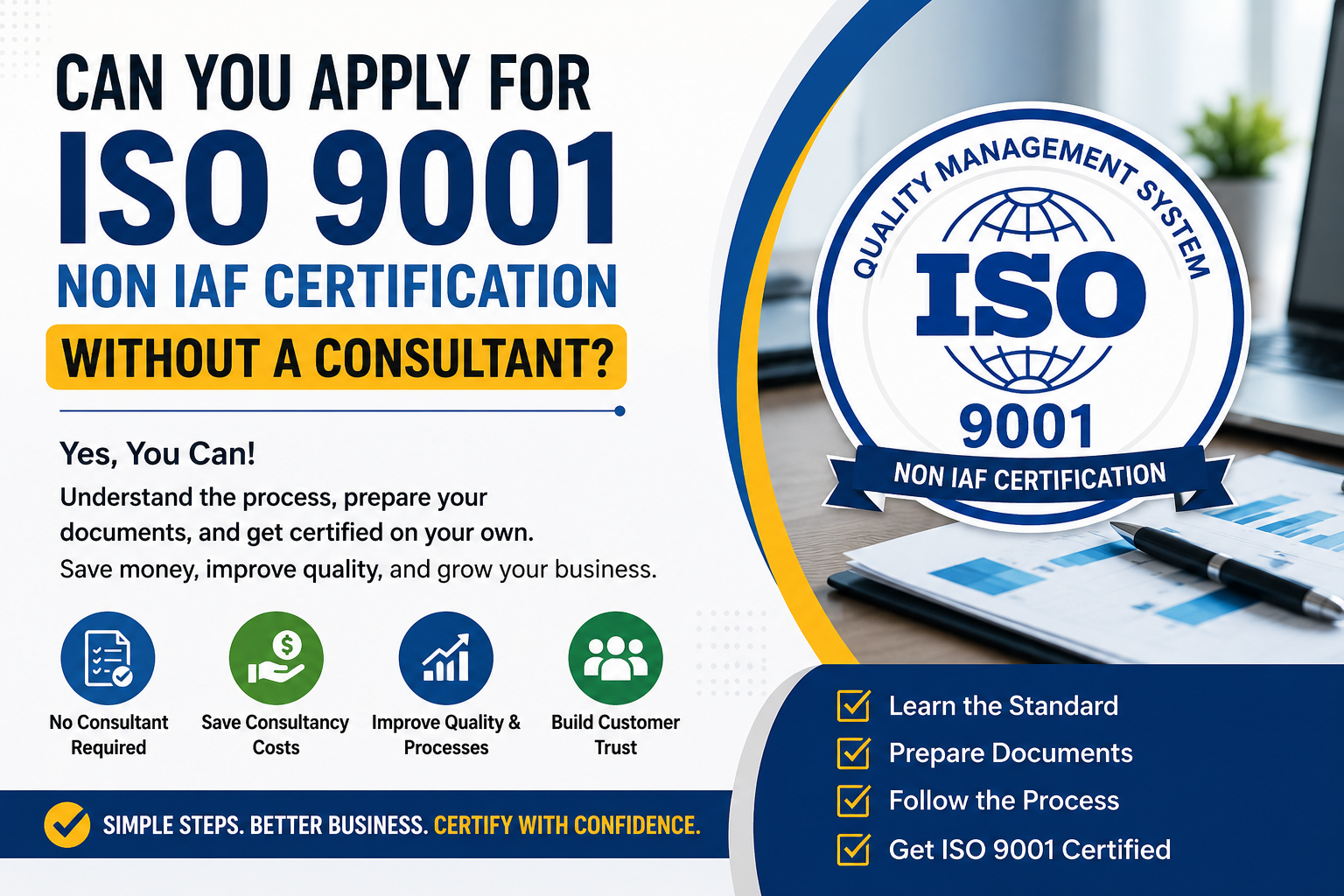
Can You Apply for ISO 9001 Non IAF Certification Without a Consultant?

Introduction
Ask around about ISO 9001 Certification and one question comes up almost every time: do I actually need a consultant for this? Most first-time applicants assume yes, mainly because the process sounds more complicated than it usually turns out to be.
Turns out a consultant isn't required at all. Learn the basic requirements, get your business documents in order, follow the certification steps carefully, and you can apply on your own. A lot of startups and MSMEs already do exactly this. It might take a bit more of your time compared to hiring someone, but it also saves money, and you end up understanding your own business processes far better than if you'd handed it off entirely.
What is ISO 9001 Non IAF Certification?
ISO 9001 is the international standard for Quality Management Systems, or QMS. It helps businesses improve product and service quality, organize daily operations, and keep customers more satisfied over time.
A Non IAF certificate comes from a certification body that isn't accredited by the International Accreditation Forum. That's the core difference. Businesses often go this route to tighten up their internal systems and show customers they take quality management seriously.
Can You Really Apply Without a Consultant?
Yes, genuinely.
Nothing in the rules says a consultant is mandatory. Put in the time to learn the process and prepare the documents properly, and the application is entirely doable on your own.
Most certification bodies walk applicants through the steps anyway and specify which documents are needed before the audit even begins. That alone makes this a lot less intimidating for smaller businesses than people expect.
Steps to Apply Without a Consultant
1. Understand the Standard
Start with the basics of ISO 9001. Becoming an expert isn't the goal here, just knowing how the standard applies to your specific business is enough to move forward.
2. Prepare Your Documents
Gather what's needed, business registration, quality policy, procedures, and other relevant records.
3. Put the System Into Practice
Documents alone won't cut it. Your team actually needs to follow these processes day to day, since that's exactly what an auditor checks for.
4. Review Your Business
Before the final audit, go through everything and confirm it's actually working the way it's supposed to. Fix whatever isn't before moving forward.
5. Choose a Certification Body
Pick one with a solid reputation. Understand how their certification process works before you submit anything.
6. Complete the Audit
The certification body reviews your documents and may run an audit. Meet the requirements, and your ISO 9001 Non IAF Certificate gets issued.
Why Some Businesses Apply Without a Consultant
Cost tends to be the biggest driver here. Hiring a consultant adds expenses that a lot of startups would rather avoid altogether. There's a second reason too, one that's less obvious upfront: business owners genuinely learn more about their own operations while preparing for certification themselves. That often leads to better organization overall, not just a certificate at the end.
Challenges You May Face
It's doable, but not effortless. Understanding the standard can eat up more time than expected, especially the first time through. Document preparation drags on longer if you've never handled something like this before. And small details sometimes slip past unnoticed until they need correcting right before the audit.
None of this is a dealbreaker though. Careful planning and proper preparation handle most of it.
Common Mistakes to Avoid
A handful of mistakes show up again and again. Incomplete documents get submitted more often than you'd think. Employee training gets skipped, or internal processes never get reviewed before the audit happens. Picking a certification body without checking their reputation first is another common slip.
Taking things slow and double-checking each step usually saves a lot of headache down the line.
When Should You Hire a Consultant?
A consultant isn't required, but there are situations where bringing one in genuinely helps. Complex business operations spread across multiple functions. A tight deadline for certification. A team with zero prior experience handling ISO standards. In these cases, professional guidance can smooth things out considerably.
For most small businesses though, going without a consultant remains a completely practical choice.
Benefits of Applying on Your Own
Handling it yourself comes with real upside. You save on consultancy costs directly. You end up learning your own business processes at a level you probably wouldn't otherwise. Internal documentation tends to improve as a natural byproduct. Employees get pulled into quality management more directly. And overall, the management system you build ends up stronger because you built it yourself.
Conclusion
Yes, ISO 9001 Non IAF Certification is completely achievable without a consultant. No rule forces you to hire one. Understand the requirements, prepare the right documents, follow the process step by step, and certification is well within reach on your own.
For startups, MSMEs, and small businesses, going this route can be a genuinely smart way to save money while still improving quality, customer satisfaction, and how the business runs day to day.
Frequently Asked Questions (FAQs)
1. Is a consultant required for ISO 9001 Non IAF Certification?
No. Hiring a consultant is entirely optional.
2. Can a small business apply without a consultant?
Yes. Plenty of startups and MSMEs complete this process on their own regularly.
3. What documents are usually required?
Business registration documents, quality policies, procedures, and other records tied to your management system.
4. Is the process difficult without a consultant?
It may take more time, but following the steps carefully makes it manageable for most businesses.
5. What is the biggest advantage of applying without a consultant?
Saving money, mainly, while also gaining a much better understanding of your own business and how it actually runs.

 English
 Chinese (Simplify)
